 Govind Tekale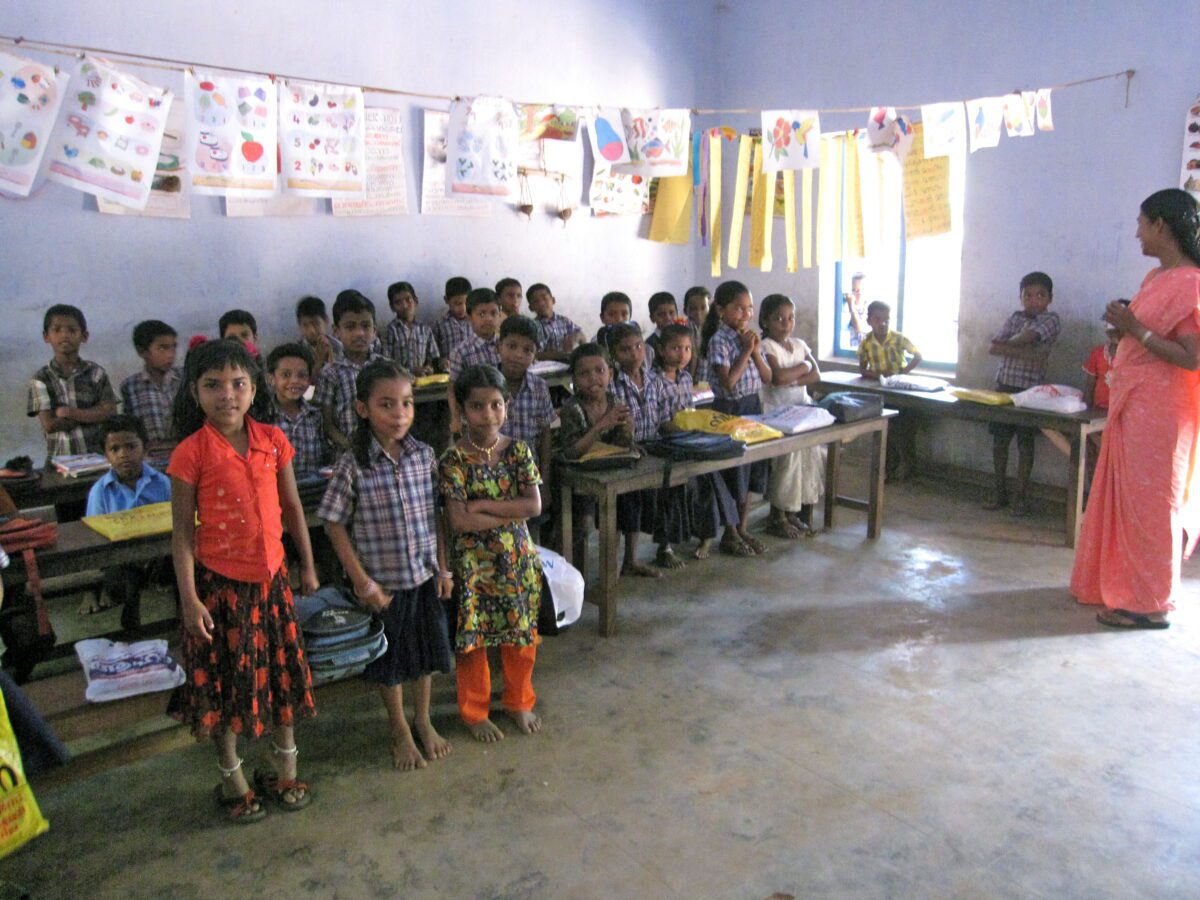
TITLE: India’s Education Gap: When the Next School Is Too Far Away
For every ten government primary schools in India, there is only one higher secondary school. This physical distance is central to understanding why a parliamentary panel found that nearly 73% of students drop out before finishing higher secondary.
The Committee on Estimates presented its Tenth Report to the Lok Sabha on August 12, 2026, based on UDISE 2024-25—the Unified District Information System for Education, a government database tracking school numbers and student counts. Chaired by Dr. Sanjay Jaiswal, the Committee found stark enrollment declines: 6.18 crore students in primary classes (grades 1–5) falling to 1.64 crore at higher secondary (grades 11–12). The Committee noted: “out of over 1 million government schools, the vast majority are only primary schools.”
India has 9.11 lakh primary schools but only 90,866 higher secondary schools. For rural and remote students, reaching a higher secondary institution means traveling long distances—a barrier for families relying on public transport or with children contributing to household work.
Several immediate problems compound the distance issue. One is the gap between curriculum and teaching materials. The Central Board of Secondary Education updated its curriculum for grades 9 through 12 to align with the National Education Policy 2020, shifting exams toward “application-based” questions that test reasoning rather than memorization. Textbooks for updated classes are still being printed and distributed. The Committee noted: “The non-availability of textbooks and newer, application-based Board examination patterns are creating significant academic stress and confusion for students especially for the students appearing for the Class 10 and 12 examinations.”
Teacher training participation also collapsed. CBSE trained more than 11 million participants over five years, free for government school teachers. Yet participation in online training fell from 5.3 million in 2022 to just 162,814 in 2025—roughly a 97% decline. Private schools in rural areas face severe constraints. These schools pay training fees plus Rs 700 per teacher for workshops. The Committee observed: “some of the non-government schools in rural or semi-urban areas do not have enough budgetary resources to send their teachers on paid trainings.”
Another barrier is examination cost. CBSE charges a uniform fee of Rs 1,600 for five subjects but waives fees only for visually impaired candidates—there is no exemption for economically weaker students. For families already struggling with commute distances and textbook costs, this examination fee can be the final obstacle.
Students with disabilities face additional barriers. According to UDISE+ 2024-25 data, of 14.71 lakh schools nationally, only 5.23 lakh have toilets accessible to children with special needs (CwSN), and only 8.08 lakh have ramps with handrails. The Committee stated: “The severe gap in the availability of CwSN friendly infrastructure shows that more than half of the schools across the country are devoid of CwSN friendly infrastructure.” Yet during 2024-25, the government allocated Rs 482 lakh to build accessible toilets but spent only Rs 2.60 lakh. For special educators, only Rs 80.50 lakh was spent against an allocation of Rs 962 lakh.
School regulation is also fragmented. India has 65 different school education boards—national boards like CBSE (27,000 schools) and CISCE, alongside state and international boards. The Committee found no regulatory mechanism controlling the establishment and expansion of private education boards. The Committee warned: “this lack of oversight might pose a direct threat to students’ future and the standardisation of secondary education across the country.”
Education sits on India’s Concurrent List, meaning both central and state governments share responsibility. Most schools fall under state administration, so while Parliament recommends policy, state governments must build and staff schools.
The Committee on Estimates presented findings based on UDISE 2024-25 data showing enrollment decline from 6.18 crore primary students to 1.64 crore at higher secondary. The report discussed the infrastructure ratio of one higher secondary school per ten primary schools, textbook distribution gaps, declining teacher training participation, fee barriers, and disability-accessible facility gaps with minimal budget utilisation.