 Rahul Somvanshi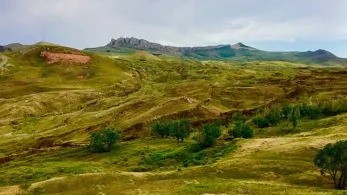
An international research team began core drilling at the Durupınar formation in eastern Türkiye on September 23, 2026. During drilling, a percussion bit broke after encountering a very hard layer about 4 to 5 metres below the surface in one of the holes. The expedition says the layer may be petrified wood. That has not been confirmed.
The drilling operation is a joint project between Sivas Cumhuriyet University and the Noah’s Ark Scans research group. The Turkish government issued official permits for the excavation. Prof. Dr. Cenker Atila of Sivas Cumhuriyet University’s archaeology department leads the site work alongside Andrew Jones, vice president of the Noah’s Ark Research Project. A dry percussion system — no cooling fluid — was used, designed for hard materials. The bit broke on contact with the dense layer rather than passing through it. Cores from other depths have been extracted to depths of up to 18 metres and are being sent for third-party laboratory testing, with results expected in 2027. A drone is planned to investigate mapped voids and corridors inside the formation once access permits it.
Until laboratory assays return results, readers should treat the current findings as active evidence-gathering, not a confirmed discovery. The field team’s working hypothesis — that the dense layer is petrified ancient timber — is one possibility. Other explanations remain possible until laboratory analysis identifies the composition of the material.
Ground-penetrating radar surveys conducted before the drilling found what the team interprets as right-angle structures and internal voids within the formation’s 157-meter boat-shaped outline. Crucially, the team says no bedrock or solid limestone has been encountered so far *inside* the formation boundary, while standard bedrock samples taken just *outside* it behave differently. A 1996 paper by Lorence Collins and David Fasold concluded that the formation was a natural geological structure. That conclusion remains the subject of debate; the 2026 drilling is the latest effort to gather direct subsurface evidence.
Did scientists find petrified wood at the Durupınar site? Researchers encountered a layer hard enough to shatter a percussion drill bit at roughly 4 to 5 meters below the surface. The team suspects this could be petrified timber or preserved structural material, but the sample has been sent for third-party laboratory testing. No confirmation of wood composition has been made. Results are expected in 2027.
For context on how ground-penetrating radar is used in archaeological surveys, see our radar archaeology explainer. See our background on the Durupınar formation’s geological history and previous investigations.
Lab results from Sivas Cumhuriyet University are expected in 2027. Radiocarbon dating could be possible if suitable organic material is confirmed in the samples. This site will publish an update when results are released.