 Sonali Tiwary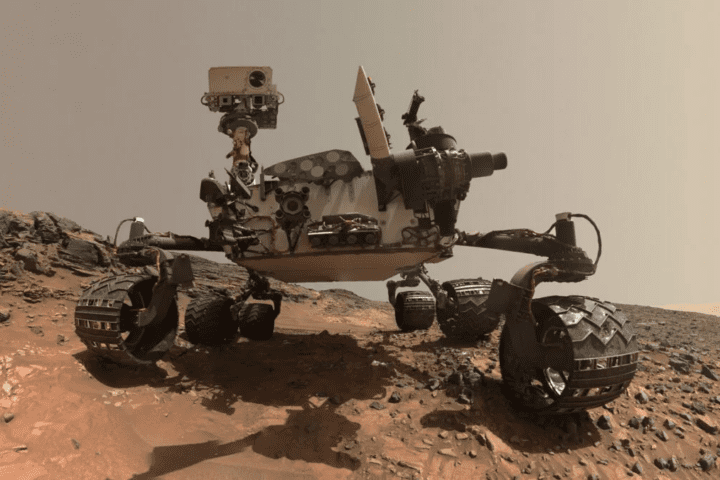
On Sol 4963 (July 23, 2026), NASA’s Curiosity rover used its MAHLI (Mars Hand Lens Imager) camera to conduct a detailed inspection of its six aluminium wheels — a routine but vital procedure that helps engineers monitor the cumulative wear from nearly 14 years of Mars surface exploration.
Curiosity has now travelled approximately 32 kilometres (20 miles) across the Martian surface since landing in Gale Crater in August 2012 — seven times its original two-year design lifespan. The wheels show dents, punctures, and tears accumulated from traversing sharp Martian rock fields, yet continue to function.
Why Wheel Inspections Matter
Curiosity’s wheels are made from 0.75mm aluminium — the minimum machinable thickness — machined with chevron-pattern treads for traction. Early in the mission, NASA engineers were surprised by the speed at which cracks and holes developed on rocky terrain. The rate of wheel degradation prompted a 2017 software update that introduced a traction control algorithm — called “traction control” — to more carefully manage wheel loading on hazardous ground.
Wheel inspections now occur approximately every 1,000 metres (3,330 feet) of driving, using MAHLI images sent back to NASA’s Jet Propulsion Laboratory for engineering analysis. Results are also published at NASA’s Curiosity mission page.
Curiosity’s Current Science Work
Despite wheel wear, Curiosity continues active science operations on the slopes of Mount Sharp (Aeolis Mons), drilling rock samples and analysing their chemistry to understand Mars’ ancient climate history. Scientists believe the mountain’s layered sediments represent billions of years of environmental change — a record that Curiosity is uniquely positioned to read.
NASA engineers at JPL express confidence the rover can continue operating for several more years, though they acknowledge each additional Sol brings new uncertainty. Curiosity’s ongoing survival is a testament to the durability of its engineering and the ingenuity of the teams managing it from 225 million kilometres away.