 Karmactive Team
 Enayat Garg
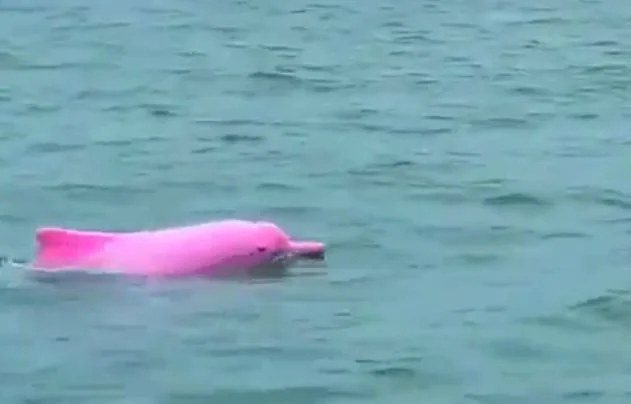
Our planet is home to many wonders in the world. People may look at monuments with amazement but the beauty of biodiversity surpasses it. The rare sighting of a pink dolphin is no less than a magical show. The video by sea shows two pink dolphins swimming side-by-side which truly is a once in a lifetime sight.
It’s said that there are only 2000 pink dolphins left in the entire world. Today biodiversity is that heritage that we need to safeguard so the earth can continue to be the beautiful planet that it was once before.
The Amazon river dolphin (Inia geoffrensis), known locally as bufeo colorado, is the only member of the family Iniidae found in freshwater environments. According to the International Union for Conservation of Nature (IUCN) Red List, this species is classified as Endangered, with population estimates ranging between 1,000 and 2,000 individuals across the Amazon Basin in Brazil, Peru, Colombia, and Ecuador.
Marine biologists from the Mote Marine Laboratory in Florida have documented that these dolphins exhibit unique pink coloration that develops with age, caused by increased blood vessel visibility through translucent skin. Studies published in the Proceedings of the National Academy of Sciences reveal that Amazon river dolphins navigate using echolocation in murky waters where visibility drops below 30 centimeters during seasonal flooding.
Conservation efforts led by the Whale and Dolphin Conservation (WDC) report that pollution, dam construction, and mercury contamination from illegal gold mining threaten the species with extinction. The Brazilian Government established five protected areas in 2019 to safeguard critical habitats along the Rio Negro and Amazon River tributaries.
The Amazon river dolphin (Inia geoffrensis), known locally as bufeo colorado, is the only member of the family Iniidae found in freshwater environments. According to the International Union for Conservation of Nature (IUCN) Red List, this species is classified as Endangered, with population estimates ranging between 1,000 and 2,000 individuals across the Amazon Basin in Brazil, Peru, Colombia, and Ecuador.
Marine biologists from the Mote Marine Laboratory in Florida have documented that these dolphins exhibit unique pink coloration that develops with age, caused by increased blood vessel visibility through translucent skin. Studies published in the Proceedings of the National Academy of Sciences reveal that Amazon river dolphins navigate using echolocation in murky waters where visibility drops below 30 centimeters during seasonal flooding periods.
Conservation efforts led by the Whale and Dolphin Conservation (WDC) report that pollution, dam construction, and mercury contamination from illegal gold mining threaten the species with extinction. The Brazilian Government established five protected areas in 2019 to safeguard critical habitats along the Rio Negro and Amazon River tributaries, while researchers from the University of California continue monitoring population trends to assess the effectiveness of these protective measures in preserving this iconic freshwater dolphin species.