 Rahul Somvanshi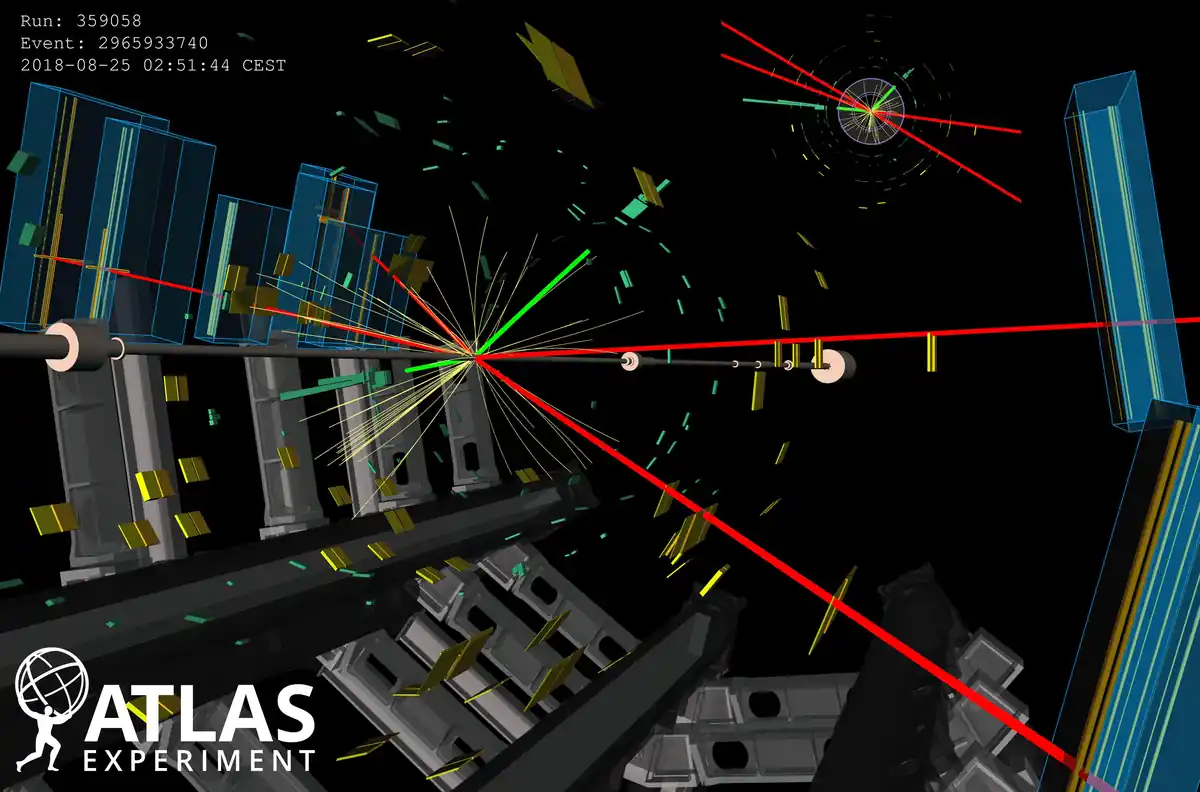
ATLAS physicists at CERN have found strong evidence of quantum entanglement between particles produced when a Higgs boson decays — the first time this fundamental quantum phenomenon has been measured at the energy levels involved in Higgs boson physics. The result was published on September 11, 2026, in Physical Review Letters, one of the most rigorous peer-reviewed physics journals.
The finding extends experimental evidence of quantum mechanics into a new energy regime, and it addresses something that had remained an open question: does quantum entanglement still operate as predicted at extreme energies approaching those of the early universe?
The answer, based on the ATLAS experiment data from the Large Hadron Collider (LHC) at CERN, is yes.
What Became Entangled — and Why It Matters
The most important precision in this story is what was actually measured. This is not quantum entanglement between two Higgs bosons. It is quantum entanglement between the Z bosons produced when a Higgs boson decays.
When a Higgs boson decays through a specific pathway known as H → ZZ* → 4ℓ (Higgs to two Z bosons, to four leptons), the two resulting Z bosons carry a quantum-mechanical relationship established at the moment of decay. The ATLAS collaboration measured the spin correlations between those Z boson pairs and found the analysis disfavoured the separable-state hypothesis at 4.7 standard deviations.
In particle physics, five sigma (5.0 standard deviations) is the conventional threshold for declaring a discovery. The 4.7-sigma result falls just below that bar under the stated assumptions, but it represents strong statistical evidence that the entanglement is real and not a random fluctuation.
Why the Higgs Decay Channel Is Unusual
The H → ZZ* → 4ℓ decay channel accounts for roughly 3% of Higgs boson decays — a rare outcome in an already rare event. The Higgs boson itself has a fleeting existence, decaying almost instantaneously after it is produced.
Quantum entanglement in simple systems — pairs of photons in low-energy laboratory experiments — has been documented extensively since the 1970s. Confirming it in massive, rapidly decaying particles at multi-GeV energy scales is a different challenge entirely. It requires precisely measuring the spin orientations of particles with extraordinarily brief lifetimes — Z bosons decay in roughly 10⁻²⁵ seconds — and tracing those measurements back to statistical predictions derived from quantum theory.
How ATLAS Measured Quantum Entanglement
The ATLAS collaboration measured spin correlations between Z boson pairs by analysing the angular distributions of the leptons produced in the H → ZZ* → 4ℓ decay. By comparing those distributions against predictions for both an entangled quantum state and a separable (non-entangled) classical state, the analysis disfavoured the separable-state hypothesis at 4.7 standard deviations.
This approach relies on Standard Model theoretical predictions. Rather than testing whether correlations exceed a classical bound in a device-independent way, the ATLAS measurement uses the Standard Model’s predicted angular distributions as a baseline against which to assess entanglement. The result provides strong statistical evidence that the Z bosons are produced in an entangled state.
Why This Result Matters for Physics
While confirming quantum entanglement at tabletop photon energies validates quantum mechanics at low energies, measuring it in massive vector bosons at LHC energy scales extends the verified range of quantum mechanics considerably. It demonstrates that quantum interconnectedness operates under conditions that existed in the earliest moments after the Big Bang.
This is a fundamental-physics measurement. Confirming that quantum entanglement persists at these extreme energy scales extends the verified range of quantum mechanics, which is relevant to theoretical models underlying quantum information research. The practical applications of quantum information technology remain in low-energy systems — this result does not directly enable new quantum computers. But the theoretical foundations are now experimentally verified across a far wider range of conditions than before.
What did CERN discover about quantum entanglement and the Higgs boson? The ATLAS experiment at CERN found strong evidence of quantum entanglement between Z boson pairs produced in Higgs boson decays. Published in Physical Review Letters on September 11, 2026, the measurement disfavoured the separable (non-entangled) state hypothesis at 4.7 standard deviations. It is the first observation of entanglement at this energy scale.
Can particles from the Higgs boson be entangled? Yes. The ATLAS experiment found strong evidence that Z bosons produced from Higgs boson decays carry quantum entanglement — their spin states are correlated in a way that disfavours a classical separable state. The specific decay channel studied, H → ZZ* → 4ℓ, accounts for roughly 3% of Higgs boson decays.
Why does high-energy quantum entanglement matter? It provides evidence that quantum mechanics operates consistently across a far wider energy range than previously measured. For fundamental physics, it extends the verified range of quantum entanglement to extreme energy scales. For quantum information research, it validates theoretical models across a broader set of conditions.
Closure
The ATLAS collaboration’s measurement of quantum entanglement in Z boson pairs from Higgs decays, published September 11, 2026, extends experimental quantum mechanics into a new energy regime. The 4.7-sigma result provides strong statistical evidence of entanglement in massive vector bosons at LHC energy scales. The next phase of LHC operation — the High-Luminosity LHC planned for 2030 — will generate significantly larger datasets and is expected to sharpen the statistical precision of this and related measurements.