 Govind Tekale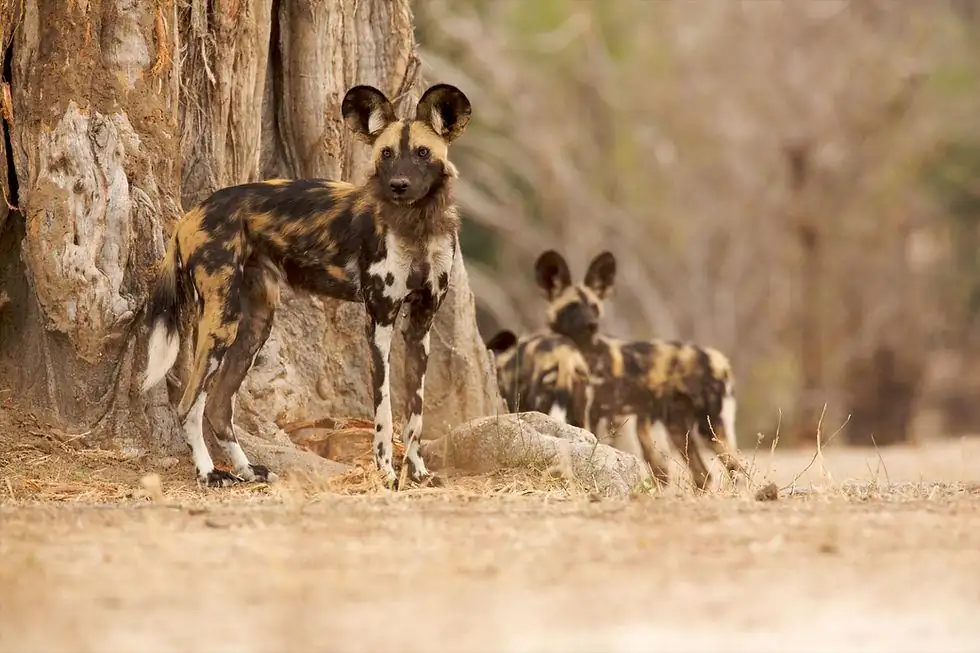
Three male African wild dogs have completed a journey of 4,126 kilometres across southern Africa — the longest recorded movement ever documented for any African mammal and the longest wild dog dispersal in scientific history. The distance is roughly equivalent to travelling from Cairo to Cape Town.
The dogs, tracked by GPS collars as part of ongoing research by the Zambian Carnivore Programme (ZCP), left their birth pack in Zambia’s Kafue National Park and spent roughly eight to nine months crossing the continent before settling in an area between South Luangwa and Lower Zambezi National Parks. The journey illustrates why connectivity between protected areas matters for wild-dog dispersal, breeding and long-term population health.
The Journey of the Mayukuyuku Coalition
The three males, known to researchers as the Mayukuyuku coalition, dispersed from Kafue National Park in search of unrelated females with whom to form a new breeding pack. Dispersal is a natural behaviour in African wild dogs — young males often disperse from their birth pack once they reach adulthood — but the distance these three individuals covered far exceeded anything previously recorded.
The research was co-authored by Dr. Matt Becker of the Zambian Carnivore Programme, the team responsible for the GPS collar monitoring that made tracking possible.
What Made This Journey Scientifically Remarkable
The raw distance — 2,564 miles — is extraordinary. But the more scientifically consequential detail is where the dogs spent that distance.
A significant portion of the Mayukuyuku coalition’s journey took place outside national park boundaries — across agricultural land, communal areas, and human-settled corridors. They navigated farms, roads, villages, and urban fringes without suffering lethal conflict with people, which is a common cause of wild dog mortality in unprotected landscapes across Africa.
That survival rate through human-dominated terrain is not guaranteed. African wild dogs are among the most endangered carnivores on the continent. They are frequently killed in snares set for bushmeat, shot by livestock farmers, and struck by vehicles. A journey of this length that ends without casualty is, by any measure, exceptional.
Why Genetic Diversity Drives These Journeys
African wild dogs live in tightly bonded packs with strict social hierarchies. Young males often disperse from their birth pack to avoid inbreeding — if they stay and breed with related females, the genetic diversity of their population collapses over generations.
Only around 6,600 African wild dogs are estimated to remain in the wild. Their numbers are concentrated in isolated protected areas across southern and eastern Africa. Without corridors connecting those populations, the surviving individuals cannot exchange genes, and even a well-managed reserve can become a genetic dead end.
The 4,126-km journey of the Mayukuyuku males, tracked through GPS collar data analysed by the ZCP, provides GPS-verified evidence that these animals will travel extraordinary distances to find genetically unrelated mates — and that they can navigate human landscapes if those landscapes are not actively hostile to them.
For more on African wild dog conservation, read about how painted dogs from Africa joined a Yorkshire pack while only 5,000 survive from the original 500,000 population.
What This Means for Conservation Policy
The Mayukuyuku coalition’s record dispersal was not a freak event. It was driven by the biological need to find unrelated mates. The conservation implication is clear: protected areas designed as islands cannot sustain viable wild dog populations indefinitely.
This research provides a concrete, GPS-verified data point for conservation planning arguments around habitat connectivity.
You can read more about how large-scale habitat design is being applied in Chester Zoo’s Heart of Africa project, which brings rhinos, zebras and more than 50 species into the UK’s biggest shared habitat.
What is the longest distance an African wild dog has travelled? The longest recorded African wild dog dispersal is 4,126 kilometres (2,564 miles) across southern Africa, completed over roughly eight to nine months by three males known as the Mayukuyuku coalition. They dispersed from Zambia’s Kafue National Park in search of unrelated mating packs.
Why do African wild dogs travel thousands of kilometres? African wild dogs often disperse from their birth pack to find genetically unrelated mates and avoid inbreeding. With only around 6,600 individuals remaining in the wild, dispersing males must cross vast distances between isolated populations. Without connected wildlife corridors, this genetic exchange becomes impossible.
Where did the Zambian wild dogs travel from and to? The Mayukuyuku coalition began their journey in Kafue National Park, Zambia, and were eventually tracked to an area between South Luangwa and Lower Zambezi National Parks — crossing agricultural land and communal areas during their roughly eight to nine-month journey.
Closure
The Mayukuyuku coalition’s GPS-tracked journey of 4,126 kilometres across southern Africa set a new record for the longest African mammal movement and the longest wild dog dispersal documented by science. The Zambian Carnivore Programme’s research was published in September 2026. Ongoing monitoring of the coalition and broader transfrontier wildlife corridor policy discussions will determine how this finding is applied to conservation planning across the region and beyond.