 Karmactive Staff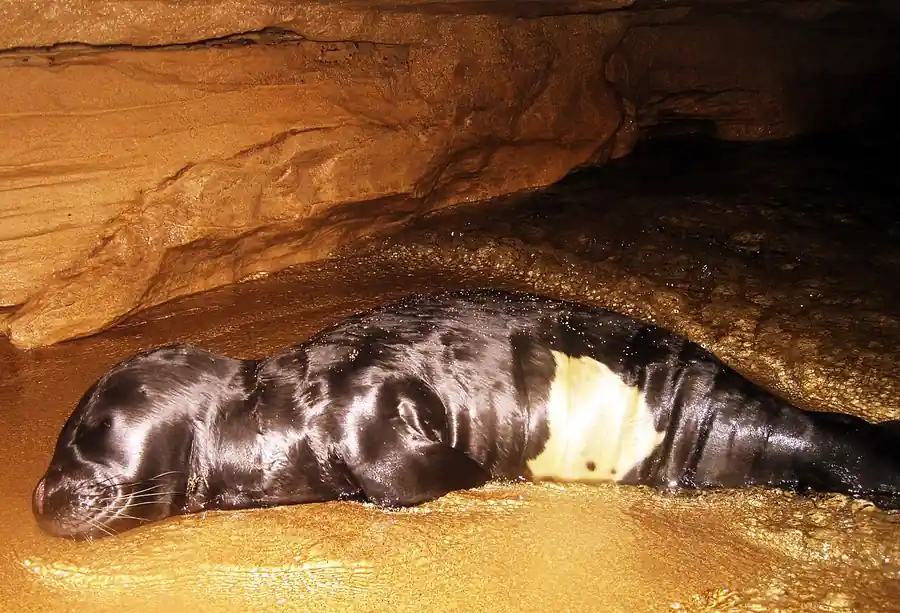
In August 2023, researchers photographing marine life near a sunken WWII warship off the Albanian coast captured something that hadn’t been recorded in that bay for 27 years: a Mediterranean monk seal.
The vessel is the Hospital Ship Po — an Italian vessel that was converted for military hospital service and sunk in 1941. It sits at between 33 and 37 meters depth in Vlora Bay, inside the Karaburun-Sazan Marine Protected Area along the Albanian coast. The ship is approximately 135 meters long and has provided hard substrate for marine organisms to colonize over the last 85 years.
Researchers conducted a detailed monitoring program between 2022 and 2024. They used scientific dives, remotely operated vehicles, high-resolution sonar, 3D photogrammetry, and biological and sediment surveys.
What they found was substantial. In the broader seabed survey around the wreck, researchers recorded 151 different benthic taxa — that’s the term for organisms living on or near the seafloor, including sponges, corals, worms, mollusks, and various invertebrates. On the wreck structures themselves, 54 distinct taxa were recorded. More than 80% of the ship’s surface was covered in what researchers describe as biogenic material — meaning living organisms had colonized most of it.
The monk seal photograph is the most striking finding. The Mediterranean monk seal, known scientifically as Monachus monachus, is one of the most endangered marine mammals in the world. The researchers describe the August 2023 photograph near the Po wreck as the first confirmed sighting in Vlora Bay since 1996. Whether the seal was using the wreck as a feeding ground, a resting area, or was passing through remains unknown — the authors say longer-term behavioral research is needed to understand how the seal is using the area.
The wreck is not entirely a conservation success story, and the researchers are careful not to present it as one. Alongside the native species, the study documented the non-indigenous devil firefish, Pterois miles, one of the northernmost reported occurrences of the species in the Adriatic. The peer-reviewed research examining this complex ecosystem establishes important ecological baselines.
The ecological picture the study presents is genuinely complex. A shipwreck provides hard structure in an otherwise soft-bottomed environment. Fish and invertebrates colonize it. A critically endangered seal turns up near it. But so does an invasive predator that wasn’t supposed to be there at all.
The researchers also found evidence of squid-family spawning on or near the wreck — another sign that the structure is being actively used by marine life.
What the study establishes is that the Po wreck has high benthic diversity and structural complexity. The researchers describe the site as having these characteristics while emphasizing that the ecological indices are preliminary and site-specific. What the study does not establish is that the wreck has restored or repaired the surrounding ecosystem. The long-term effects, including how the monk seal and the devil firefish each continue to use the area, are still being studied.