 Rahul Somvanshi
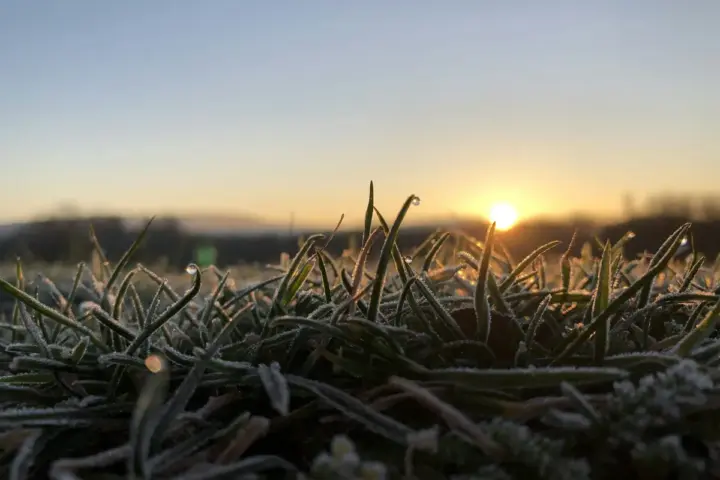
As autumn gives way to winter across the Arctic, the ground does not immediately freeze solid. Instead, soils often linger near the freezing point for days or even weeks in a phase called the zero curtain — a subsurface thermal plateau where latent heat keeps temperatures near zero as water transitions between liquid and solid states. Now, a new NASA-led study has produced the first high-resolution maps of this hidden phenomenon, revealing that moisture-rich regions of the circum-Arctic experience zero-curtain conditions for significantly longer periods than drier interior areas, with implications for the release of one of Earth’s largest carbon reservoirs.
The study, published August 22, 2026 in the journal Scientific Reports, introduces GeoCryoAI — an artificial intelligence framework that combines three decades of satellite observations with over 62.7 million in situ measurements dating back to 1891. By merging remote-sensing data from the recently launched NASA-ISRO Synthetic Aperture Radar mission (NISAR) with historical ground records, GeoCryoAI creates the first detailed maps of zero-curtain duration, intensity, and extent across the circum-Arctic region. The maps show that spring thaw produces longer zero-curtain periods than autumn freeze-up, and that higher soil moisture drives the greatest variability — accounting for 60 to 90 percent of duration differences, amplified 20 to 40 percent under warming conditions.
The reason this matters is straightforward: during the zero-curtain phase, liquid water persists in the soil, microbes remain metabolically active, and the rate of organic matter decomposition accelerates. Arctic permafrost stores approximately 1.7 trillion metric tons of organic carbon — nearly twice the amount currently circulating in Earth’s atmosphere as a result of human activity since the Industrial Revolution began. As the zero-curtain window lengthens under rising temperatures, a larger fraction of that carbon becomes accessible to microbial decomposition, converting previously frozen organic matter into carbon dioxide and methane that amplify global warming through a feedback loop known as carbon-climate coupling. This dynamic mirrors concerns raised in one of the world’s largest carbon time bombs hidden in the Arctic.
The GeoCryoAI framework was built to resolve a critical observational gap in climate modeling. Most Earth system models treat permafrost carbon as a binary thaw-or-remain-frozen parameter, without representing the intermediate zero-curtain state that allows for gradual rather than abrupt carbon release. By contrast, GeoCryoAI enables models to simulate the progressive, seasonally modulated emissions that the zero curtain facilitates — offering a more realistic projection of how permafrost carbon will contribute to future warming. Validation experiments showed that the AI framework achieves greater than 93 percent accuracy in component validation tests.
The research team, which includes scientists from NASA’s Jet Propulsion Laboratory, the US Geological Survey, the University of Alaska Fairbanks, the Norwegian Institute for Nature Research, and Columbia University’s Lamont-Doherty Earth Observatory, plans to release the full circum-Arctic zero-curtain dataset publicly in September 2026. Antarctic ice loss and defrosting permafrost both signal the urgency of improved monitoring, as Arctic permafrost alone holds nearly twice the carbon currently in the atmosphere. The dataset’s NISAR-ready monitoring protocol establishes a standardized method for tracking zero-curtain phenomena across permafrost regions, enabling 3 to 6 month forecasts of carbon release potential.
For climate modelers and policy makers alike, the study’s central finding is deceptively simple: the boundary between freeze and thaw in the Arctic is not a line but a process — a prolonged thermal transition that governs the release of carbon stored in frozen ground. As the Arctic warms at two to four times the global average, the zero curtain’s duration and extent will determine how much of that carbon re-enters the atmosphere, and how quickly the planet’s climate equilibrium shifts. This parallels earlier findings about Earth’s cooling aloft and human-induced climate fingerprints, where seemingly small atmospheric dynamics cascade into planetary-scale consequences.