Sunita Somvanshi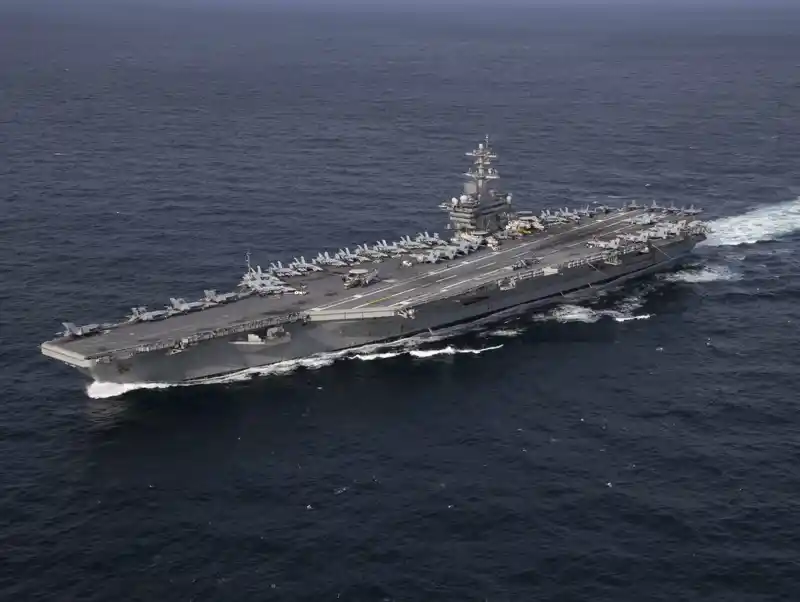
President Trump has signed a National Security Presidential Memorandum ordering the U.S. Navy to replace electromagnetic aircraft launch systems on its newest carriers with steam catapults and hydraulic elevators — technology that hasn’t been manufactured for the military in over two decades.
The order applies to the Ford-class [carrier fleet](https://www.karmactive.com/spacexs-starshield-musks-new-galactic-deal-with-pentagon/), the most advanced and expensive warships ever built. It creates a direct conflict with USS Doris Miller (CVN-28), which is already 50 percent complete at Newport News Shipbuilding with electromagnetic systems already installed.
“When we build aircraft carriers, it’s steam for the catapults and it’s hydraulic for the elevators. We’ll never have a problem,” Trump said, according to administration statements.
The decision raises immediate questions about cost, construction delays, and whether retrofitting mid-construction ships is even technically feasible. Secretary of Defense Pete Hegseth has been ordered to submit a readiness report within 120 days on implementing the change.
**Why This Matters for National Security**
The electromagnetic launch system, called EMALS, was built by General Atomics. It replaced steam catapults starting with the USS Gerald R. Ford in 2017. The Navy spent decades developing EMALS because it offers precision control and reduced maintenance compared to steam.
Trump has been publicly critical of EMALS for years, calling it “too complex” and “too costly.” The administration’s memo does not provide a detailed cost estimate for the reversal, but defense experts say retrofitting could exceed billions of dollars.
General Atomics issued a statement saying the change “warrants careful reconsideration of the implications for carrier readiness, national security, and U.S. technological superiority.”
Bryan Clark, a senior fellow at the Hudson Institute who studies naval operations, laid out the core problem: “Restoring steam lines to at least the catapults will require extensive redesign of the ship.”
This is not a simple swap. The Ford-class carriers use electricity for cooking, heating, water purification, the catapult system, and arresting gear that stops landing planes. Removing EMALS means redesigning how power flows through the ship.
**The USS Doris Miller Dilemma**
USS Doris Miller is the central problem. It is halfway through construction at Newport News, with electromagnetic catapult systems already installed and integrated into the ship’s electrical systems.
General Atomics, which built EMALS, warned that changing course at this stage would introduce significant cost overruns, schedule delays, and technical integration problems. The company noted that nearly half of the ship’s production is complete, making a reversal particularly risky.
HII’s Newport News Shipbuilding is the only facility in the United States capable of building nuclear-powered aircraft carriers. Any delay or redesign at this point would push back the delivery of CVN-28, potentially leaving a gap in the Navy’s carrier schedule at a time when the Pentagon is trying to maintain a 355-ship fleet.
**The Industrial Base Problem**
No defense contractor has manufactured steam catapults for U.S. Navy ships since the early 2000s. The industrial base for this technology has largely shut down. Bringing it back means either rebuilding that capacity from scratch or locating another path forward.
The Navy has not purchased a steam catapult in more than 20 years. That means the supply chain—the foundries, the machining facilities, the skilled workers—no longer exists at scale. Re-establishing it would require substantial upfront investment and time.
**The Fifth Shipyard**
Beyond the carrier issue, the memorandum also orders the establishment of a fifth public shipyard dedicated to submarine repair. The United States currently has four public shipyards: in Virginia, Maine, Washington, and Hawaii. These facilities handle maintenance and modernization for the Navy’s nuclear-powered aircraft carriers and submarines.
A fifth shipyard would address a growing bottleneck in submarine maintenance. The Navy’s fast attack submarine fleet is expanding, and the existing yards cannot keep up. The memorandum directs Secretary of Defense Pete Hegseth to submit a proposal within 120 days on where to build the new yard, how many drydocks it needs, and how to finance it.
OMB Director Russ Vought said in June that the administration was “pushing hard for an additional public shipyard” to accommodate the Navy’s growing fleet. The Navy’s fleet expansion plan is estimated at $1.5 trillion over the coming decades.
Chief of Naval Operations Admiral Daryl Caudle told reporters in April that the Navy has been examining the possibility of a fifth public shipyard. He raised a key concern: “A new yard is expensive, and so is that infrastructure worth it if I can’t get the workforce there?”
**Timeline and Next Steps**
Secretary Hegseth’s 120-day report is due in early November 2026. The report should clarify how the Navy plans to handle USS Doris Miller, what the actual cost will be, and whether steam catapults can be brought back into production on schedule.
Until that report arrives, construction on USS Doris Miller continues with EMALS systems in place. The Navy has not announced any halt to work.
The broader question is whether reversing course on EMALS makes strategic sense. The U.S. faces rising competition from China and Russia, both developing advanced military technology. Choosing an older, simpler system might save money short-term. But technological regression in military hardware sends a signal about America’s direction.
Ford-class carriers are scheduled for decades of service. The catapult systems will launch and recover aircraft for 50 years or more. That’s a long time to live with a decision made in 2026.
The Trump administration believes steam is the right choice. Experts worry about cost, delay, and whether the industrial base can actually deliver. The coming months will reveal which side the Pentagon’s analysis supports.