2026 Australian Grand Prix · Season Opener
When the Car
Becomes a Hazard
Honda engine vibrations in the AMR26 risk permanent nerve damage to Alonso and Stroll — well before the 58-lap race distance at Albert Park.
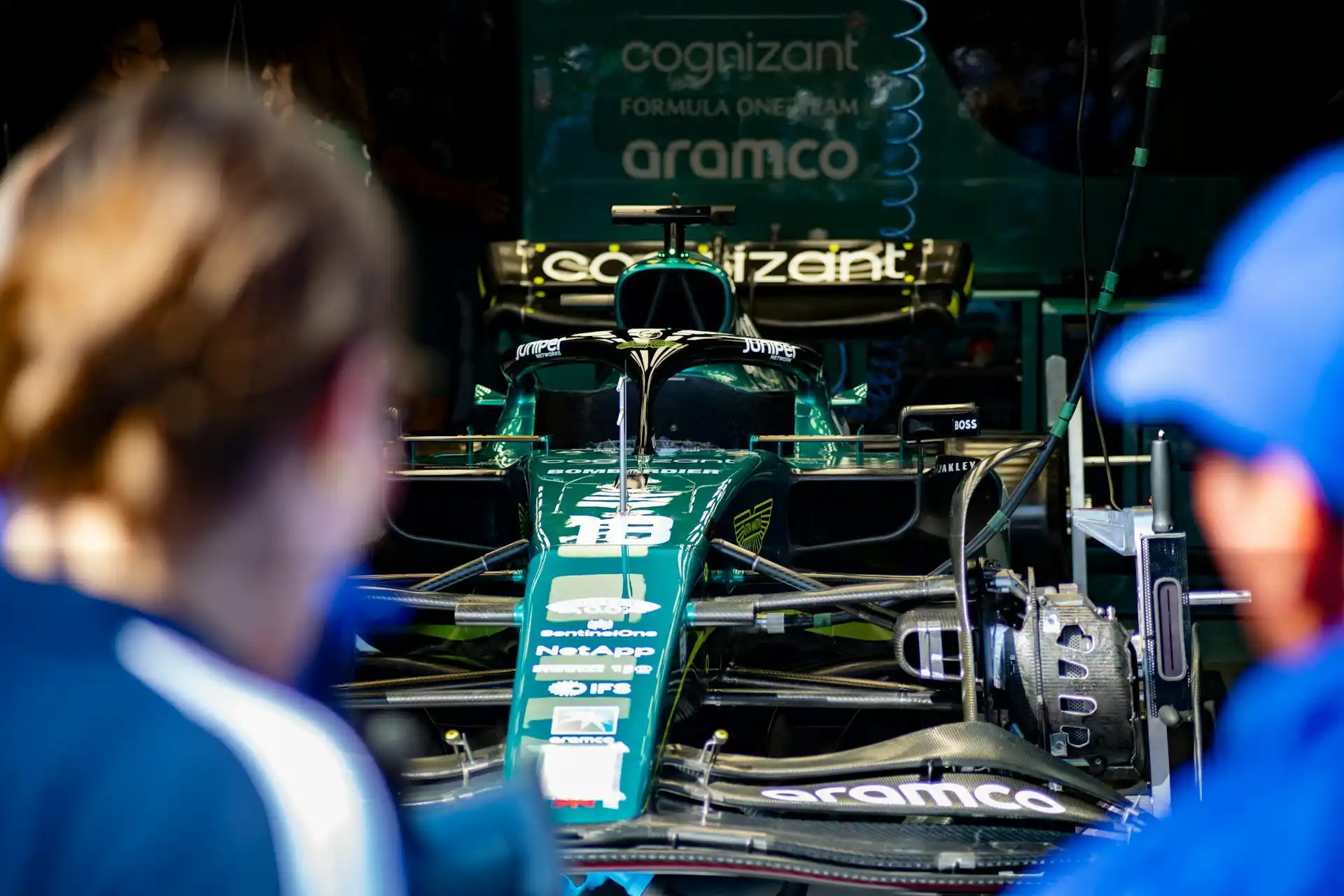
The 2026 Formula 1 season was set to open in Melbourne as a showcase of new technical regulations — a 50-50 power split between combustion and electric systems, new chassis rules, and 100% sustainable fuels. For Aston Martin, however, the weekend arrived with a far more pressing concern: the safety of its own drivers.
Team Principal Adrian Newey, speaking at a Thursday press conference at Albert Park, confirmed that extreme vibrations from the team’s new Honda 2026 power unit are being transmitted through the AMR26 chassis directly into the steering wheel — and into the hands of Fernando Alonso and Lance Stroll. The situation has created strict lap limits for both drivers to avoid permanent nerve damage.
Fernando Alonso has reported he cannot safely run more than 25 consecutive laps before risking permanent nerve injury. Lance Stroll — who fractured both wrists in a cycling accident before the 2023 season and underwent further wrist surgery in 2025 due to ongoing complications — puts his limit at just 15 laps. The Australian Grand Prix runs to 58 laps, meaning a race finish for either driver appears highly unlikely without an immediate fix.
“Fernando is of the feeling that he can’t do more than 25 laps consecutively before he will risk permanent nerve damage to his hands. Lance is of the opinion that he can’t do more than 15 laps before that threshold.”
— Adrian Newey, Team Principal, Aston Martin F1
The issue is not cosmetic. During pre-season testing in Bahrain, the vibrations physically shook mirrors and tail lights off the car, and repeatedly caused the energy store battery to fail — leaving the team with the fewest laps of any constructor at the end of the pre-season testing campaign, completing just 128 laps in total — the lowest of all 11 teams. On the final day of the second Bahrain test, Aston Martin managed just six laps before running out of spare battery parts.
Honda Racing Corporation (HRC) President Koji Watanabe confirmed a countermeasure has been introduced for Melbourne to protect the battery from vibrations, based on extensive dyno testing. He was clear, however, that its real-world effectiveness was not yet guaranteed.
“Its effectiveness cannot yet be fully guaranteed under the real track conditions, so certain conditions will be applied to power unit operation this week.”
— Koji Watanabe, HRC President, Honda Racing Corporation
Critically, the countermeasure only addresses the battery. It does not stop vibrations reaching the chassis or the steering column. Watanabe also admitted the root cause of the vibrations has not yet been identified.
The 58-Lap Problem: How Far Can They Go?
Explore the lap-limit safety thresholds, Honda’s power deficit, and the vibration path through the AMR26. Tap each section to learn more.
lap limit
lap limit
laps (AUS GP)
power deficit
behind rivals
Shortfall in ICE power → car draws more from ERS to compensate → battery depletes faster → ERS unavailable on straights → car is slow and exposed → more ERS needed again. A cycle with no self-correcting mechanism until the battery is fully flat.
The V6 internal combustion engine generates “abnormal” vibration during its combustion cycle. Newey described the power unit as both the source and the amplifier of these vibrations, though Honda has stated the root cause had not yet been identified as of the Melbourne race weekend.
Vibrations travel from the engine through the transmission and gearbox assembly into the structural elements of the car.
The stiff carbon fibre monocoque transfers vibration energy to the cockpit with minimal absorption. Mirrors and tail lights have physically vibrated free during sessions.
Newey stated the vibration is “transmitted ultimately into the driver’s fingers.” The fix introduced for Melbourne addressed battery isolation only — the transmission of vibration through to the steering and hands remained unresolved.
Alonso reported feeling numbness in hands and feet after around 20 to 25 minutes of running. Hand-Arm Vibration Syndrome (HAVS) is a recognised condition associated with prolonged vibration exposure that can permanently damage nerves and blood vessels in the hands.
The 2026 FIA Technical Regulations introduced two significant changes relevant to Honda’s struggle. First, the elimination of the MGU-H — the heat-recovery motor-generator — which previously played a role in dampening engine oscillations. Second, the mandatory use of 100% sustainable fuels, supplied by Aston Martin’s partner Aramco, which carry different combustion and thermal efficiency characteristics than previous fuels.
Newey was direct about the performance gap. He estimated the AMR26 chassis is fifth fastest in the field, trailing the leading cars by between three-quarters and one second per lap. He attributed this partly to the four-month aerodynamic deficit and partly to the ICE-electrical power spiral. He expressed confidence, however, in Honda’s long-term ability to bring the power unit up to competitiveness.
“Do I believe in our partners and Honda’s ability to bring that power up and to be competitive? Absolutely. They have a proven track record, and we have total faith.”
— Adrian Newey, Team Principal, Aston Martin F1
The parallels with battery technology challenges in road vehicles are notable. Energy storage reliability under physical stress and vibration is a known challenge across electric and hybrid platforms, from consumer EVs to race-use systems. The specific issue here — vibration causing battery failure rather than just degradation — is particularly acute given the FIA’s restricted parts allocation rules: failures that require new battery or power unit components may trigger grid penalties for later races in the season.
Alonso was measured in describing the situation. He said the vibrations caused his hands and feet to feel numb after around 20 to 25 minutes of running, adding:
“If we were fighting for the win, we can do three hours in the car, let’s be clear. But definitely it is something that is unusual. It shouldn’t be there. We don’t know the consequences either if we keep driving like that for months. So a solution has to be implemented.”
— Fernando Alonso, Driver, Aston Martin F1
Alonso confirmed the team’s approach would be shaped by what was learned in practice and qualifying — that a race strategy would only be set once the impact of Honda’s countermeasure was better understood on track. The team’s broader brand ambitions beyond F1 are not in question, but the technical partnership with Honda is under clear short-term strain.
This article covered the technical and driver safety situation Aston Martin faced at the opening round of the 2026 Formula 1 season in Melbourne. The key points discussed included the lap-limit thresholds set for Fernando Alonso (25 laps) and Lance Stroll (15 laps) due to vibration-related nerve damage risks, the battery reliability failures in pre-season testing, and Honda’s unconfirmed countermeasure for Albert Park. The article also covered the 2026 FIA regulatory context, the power unit deficit estimated at 50kW below the ERS ceiling, and the aerodynamic development gap resulting from the team’s delayed wind tunnel access.
The article also covered the timeline of Honda’s formal works return to F1, the development delays linked to Honda’s 2021 withdrawal announcement and subsequent compressed R&D window, and Adrian Newey’s own compressed timeline since officially starting work at the team on March 1, 2025. Further context on advanced battery system engineering and motorsport electrification challenges was referenced for broader technical context.