Greater Cincinnati Under Flood Watch as Miami Rivers Rise After 2.5 Inches of Rain
The National Weather Service in Wilmington has extended a Flood Watch through Thursday afternoon. With soils saturated and another 1–3 inches forecast, river levels are expected to keep climbing.
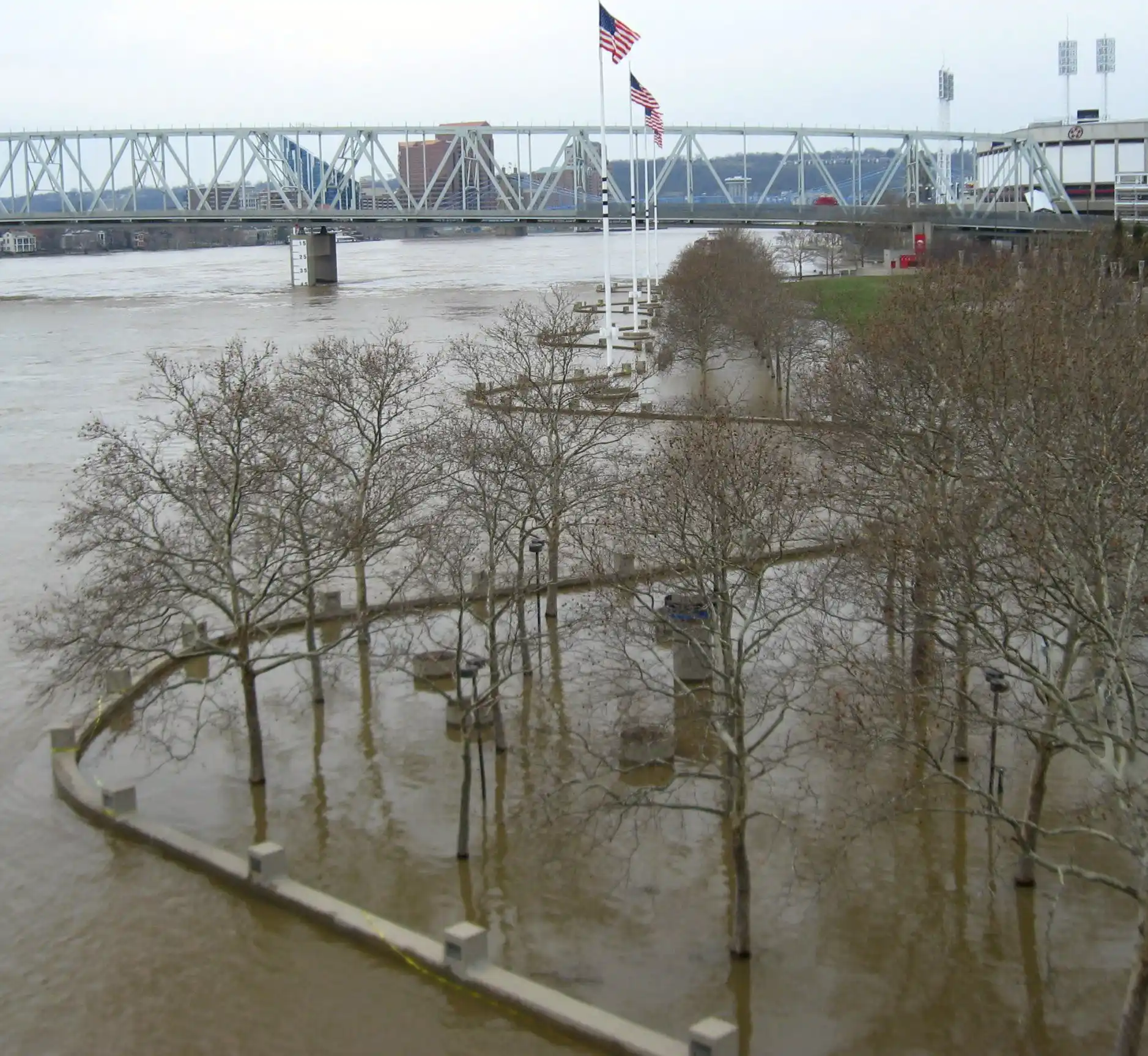
Heavy rainfall soaked Greater Cincinnati over the 24 hours leading into Thursday, March 5, 2026, depositing between 1 and 2.5 inches across the region. The National Weather Service in Wilmington has extended a Flood Watch through Thursday afternoon as saturated ground sends water rapidly into already-swollen rivers.
Flood Warnings are active for the Little Miami River at Milford and the Great Miami River at Miamitown. The Ohio River at Cincinnati is tracking toward action stage — the level before minor flooding begins. A Flash Flood Warning has also been issued for Dearborn, Franklin and Ripley counties in Indiana until early Thursday morning.
By midday Thursday, some locations are forecast to surpass 3 inches of total rainfall since Wednesday. The Weather Prediction Center has placed the Ohio River Valley under a marginal to slight risk for excessive rainfall — meaning forecast rain totals may exceed local flash-flood guidance in places.
Live River Status
Where the Water Is Rising Right Now
River stage data sourced from USGS and NOAA Water Prediction Service. Tap a card for source data.
At 18 ft, Karl Brown Way in Loveland and Round Bottom Road in Anderson Township flood. USGS Live Gauge →
At 23 ft, flooding impacts low-lying areas south of Miamitown, from New Baltimore to Cleves, with businesses on the east side near Taylor Creek and stretches of East Miami River Road flooded. NOAA Gauge →
Below flood stage but riverfront businesses should monitor. NOAA Water →
Smaller streams and creeks near main basins can rise quickly. NWS Wilmington →
USGS provisional data for the Great Miami River at Miamitown (station 03274615) shows stages rising steadily as runoff from saturated soils continues to pour into the basin. Forecasters at the NWS Wilmington office say several smaller streams and creeks near the Great Miami, Little Miami and lower Scioto river basins may rise quickly during and after the next wave of rain.
The Storm Prediction Center noted that a return of milder air from the south is providing enough atmospheric instability — combined with strong wind shear — to support a few stronger storms, particularly late Thursday afternoon and into the evening. While this is not a major severe weather setup, some storms could produce gusty winds alongside heavy downpours.
“Turn Around, Don’t Drown.” Most flood-related fatalities occur in vehicles. As little as 6 inches of moving water can knock an adult off their feet, and 12 inches can sweep away most small cars.
Day by Day Forecast
What the Rest of the Week Looks Like
Greater Cincinnati Weather Timeline — March 5–10, 2026
Know Your Alerts
What Each Flood Alert Actually Means
The Four Levels of Flood Alerts
Issued by the National Weather Service — tap each tab to understand what action to take
Flood Advisory
A heads-up that a weather event may bring some flooding. Conditions could change. Stay aware and check back for updates from the NWS Wilmington.
Flood Watch
Conditions are favorable for flooding to occur — like extended heavy rain over saturated soil. A Flood Watch does not mean flooding will definitely happen, but preparations should begin now. Sign up for AlertHC.
Flood Warning
Flooding is imminent or already happening. This is a call to action. Move to higher ground if you are in a flood-prone area. Check OHGO for road closures and avoid driving through any standing water.
Flash Flood Warning
A flash flood is occurring or about to occur. Flash floods can develop in minutes to hours. They can strike areas not currently receiving rain. If in a flood-prone zone, move immediately to high ground. Do not wait. Contact Hamilton County EMA if you have mobility or medical needs.
Your Flood Safety Checklist
Tap each item to check it off as you prepare
- Sign up for AlertHC and Smart911 for real-time emergency notifications from Hamilton County EMA.
- Check OHGO.com or the ODOT app before driving — active road closures are posted for State Route 52 and other river-adjacent highways.
- Never drive through flooded roads. 6 inches of moving water can knock a person over; 12 inches can sweep away a small car.
- Check sump pumps and clear storm drains near your home of debris to prevent localized street flooding.
- If you have mobility or health issues, call Hamilton County EMA or register with Smart911 so emergency crews know your needs before an evacuation is necessary.
- Identify the nearest high ground or shelter in your neighborhood and share the plan with your household before conditions worsen.
- Keep updated through NWS Wilmington and the WPC Excessive Rainfall Outlook for evolving forecasts.
While the attention this week is on immediate flooding, the region has a long history with these rivers. The Miami Conservancy District — the first regional flood-control system in the United States — was established after the catastrophic Great Flood of 1913, which killed more than 360 people across Ohio. The dry dams and levees built by the Conservancy protect major urban centres, but smaller waterways like the Mill Creek and Little Miami remain sensitive to rapid runoff.
Urban flood preparedness strategies continue to evolve as spring weather patterns shift toward more frequent, high-intensity rainfall events. The sustained soil saturation seen in early March 2026 reflects what climate scientists have flagged as a broader trend toward more active spring seasons across the Ohio Valley.
A River Region With a Long Flood Memory
The Great Miami and Little Miami rivers have flooded repeatedly throughout recorded history. The Great Flood of 1913 — the deadliest natural disaster in Ohio’s history — killed over 360 people and led directly to the creation of the Miami Conservancy District, which built a system of retarding basins and levees still in operation today.
Despite that infrastructure, minor and moderate flooding on smaller tributaries — including the Mill Creek in Evendale and the Little Miami at Milford — occurs multiple times each decade. Flood events globally have become a recurring challenge for cities built near river systems, and Cincinnati is no exception. The interaction of urban drainage, plastic debris and flood risk has also been studied in connection with how well waterways can handle peak flows.
USGS historical data for these rivers is available at waterdata.usgs.gov for those who want to review past stage statistics and high-water records.
Official Sources — Live Alerts & Data
Summary
The Situation Was Covered — Here Is What Was Reported
The weather event affecting Greater Cincinnati through March 5, 2026 involved 1 to 2.5 inches of initial rainfall over 24 hours, followed by a secondary round of storms forecast to bring another 1–3 inches. Flood Warnings were issued for the Little Miami River at Milford and the Great Miami River at Miamitown as both approached and reached minor flood stage. A Flash Flood Warning was in effect for Dearborn, Franklin and Ripley counties in Indiana. The Ohio River at Cincinnati was tracked toward action stage.
Saturated ground conditions — resulting from 2–4 inches of rain in the final week of February and the first days of March — were noted as contributing factors increasing runoff. Emergency agencies, including Hamilton County EMA, emphasised road safety and the “Turn Around, Don’t Drown” protocol throughout the event. Rainfall was forecast to taper off Thursday night into Friday, followed by another cold front arriving Saturday.
More on extreme weather patterns and their broader environmental impact has been covered on KarmActive, including research on climate change and its rising toll.