 Karmactive Staff
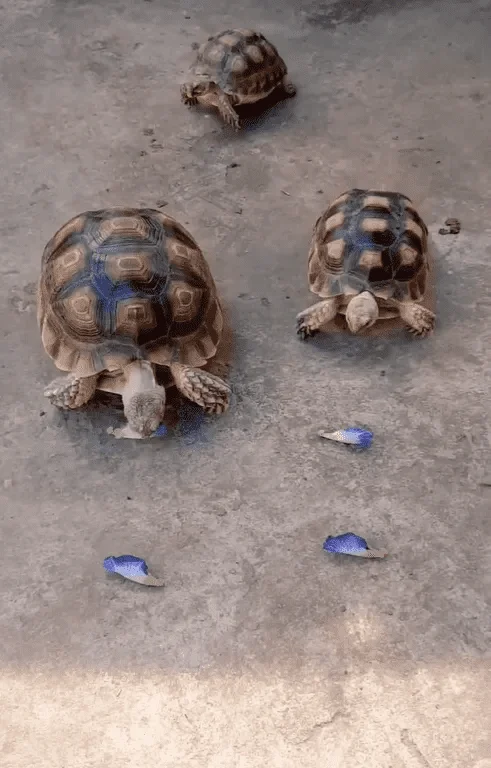
Rabbit and tortoise story is very famous but have you ever seen a tortoise racing another tortoise? Due to the temptation of tasty Asian pigeonwings flowers, the two Sulcata tortoises are seen racing each other. When the two are about to completely devour their share we can see the third tortoise joining them.
Egg family turtle is a blogger who posts about their tortoises and family. They too are based in Thailand, and their turtles and tortoises are internet stars.
Tortoise racing behavior reveals fascinating aspects of these ancient reptiles competitive nature and speed capabilities that challenge common perceptions about these slow-moving creatures. While tortoises are indeed slow, some species can reach surprising speeds when motivated by competition or mating opportunities, demonstrating that their evolutionary adaptations serve specific purposes in survival and reproduction strategies. The physics of tortoise movement involves unique biomechanical principles that allow these heavy creatures to navigate diverse terrains including hills, sand, and rocky surfaces with remarkable stability and efficiency across various environmental conditions and seasonal changes.
Research has shown that tortoises can maintain steady movement speeds of up to 0.3 kilometers per hour for extended periods, with short bursts reaching faster rates when necessary for escaping predators or reaching water sources. These movement patterns depend on temperature regulation, energy conservation strategies, and habitat requirements that vary by species across different geographic regions including the Galapagos Islands, Mediterranean regions, and African savannas where these remarkable reptiles have adapted to diverse environmental conditions and evolved unique characteristics including shell morphology, dietary preferences, social behaviors, and hibernation patterns that reflect millions of years of evolutionary adaptation to changing climates, predation pressures, and resource availability patterns that have shaped their behavior genetics and physiology across multiple generations and species of tortoises and turtles worldwide.
See: related article.
See: related article.
See: related article.