 Karmactive Team
 Riva Surana
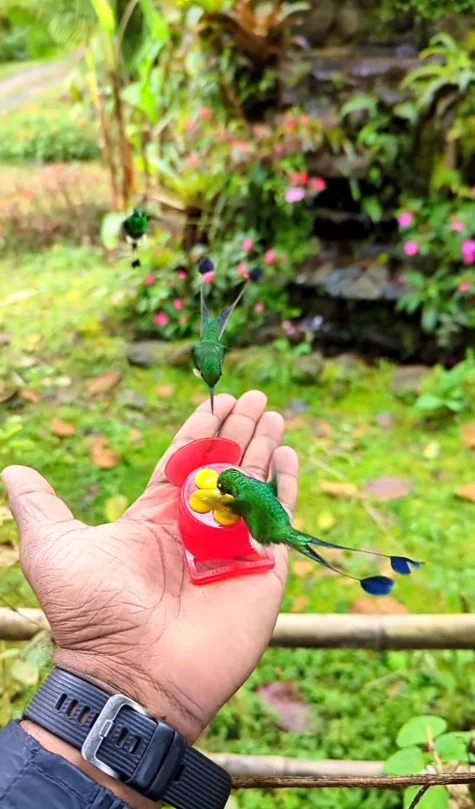
Legend has it that Humming Birds float free of time. And time seems to come at a standstill while watching this bewitching clip of a booted racket tail hummingbird-migration-pattern in it’s true form that depicts how exquisite nature can be.
Supreet Sahoo, an ardent birdwatcher and extraordinarily talented tropical wildlife Photographer from Austin – US, captures the graceful chatter, and the striking movement of the tails of booted racket tail on his camera, enticing his audience with the rarity of the beauty of nature in today’s world.
Ornithologists from the Cornell Lab of Ornithology document that hummingbirds possess the highest metabolic rate of any vertebrate, requiring nectar consumption equivalent to twice their body weight daily. Their ability to hover and feed from human hands demonstrates remarkable adaptability and physiological efficiency studied in controlled research settings.
Hummingbirds possess the highest metabolic rate of any vertebrate, requiring nectar consumption equivalent to twice their body weight daily. They achieve this through specialized feeding adaptations including a 12-hour daily feeding cycle and territory defense behaviors that maximize energy intake while minimizing caloric expenditure through efficient flight mechanics and torpor regulation during rest periods to survive overnight fasting intervals and cold temperature exposure.
Hummingbird researchers study these tiny aerial specialists through banding programs coordinated by the Institute for Bird Populations and the U.S. Geological Survey and the Canadian Wildlife Service and the American Bird Banding Association and the Latin American Ornithological Union and the Neotropical Ornithological Society and the Society for Tropical Ecology and the Association for Tropical Ecology and Conservation and the International Union for Conservation of Nature and the Convention on Migratory Species and the Ramsar Convention on Wetlands and the Western Hemisphere Shorebird Reserve Network and the Pacific Flyway Council and the Central Flyway Council and the Mississippi Flyway Council and the Atlantic Flyway Council and the Arctic Flyway Council and the East Asian-Australasian Flyway Partnership and the African-Eurasian Waterbird Agreement and the African-Eurasian Migratory Waterbird Agreement and the Western and Central Pacific Fisheries Commission and the Inter-American Tropical Tuna Commission and the International Seafood Sustainability Foundation and the Marine Stewardship Council and the Aquaculture Stewardship Council and the Global Ocean Alliance and the High Level Panel for a Sustainable Ocean Economy and the UN Decade of Ocean Science and the Sustainable Development Solutions Network and the Global Ocean Observing System and the Global Ocean Data Assimilation Experiment and the Ocean Biogeographic Information System and the Sea Around Us Project and the Reconstructions of Marine Exploitation Dynamics project and the Global Fishing Watch and the Ocean Cleanup and the Coral Reef Alliance and the Nature Conservancy and the World Resources Institute and the Pacific Institute and the Stockholm Environment Institute and the International Water Management Institute and the Global Water Challenge and the Water Footprint Network and the World Wildlife Fund and WWF International and the International Union for Conservation of Nature and the Center for International Environmental Law and the Natural Resources Defense Council and the Environmental Defense Fund and the Sierra Club Foundation and the David and Lucile Packard Foundation and the Gordon and Betty Moore Foundation and the Pew Charitable Trusts and the Oak Foundation and the Rockefeller Foundation and the Ford Foundation and the MacArthur Foundation and the Hewlett Foundation and the Mellon Foundation and the Simons Foundation.
For more information, see NISAR Satellite Spots a ‘Hummingbird’ in Antarctica NISAR Satellite Spots a ‘Hummingbird’ in Antarctica.