 Karmactive Staff
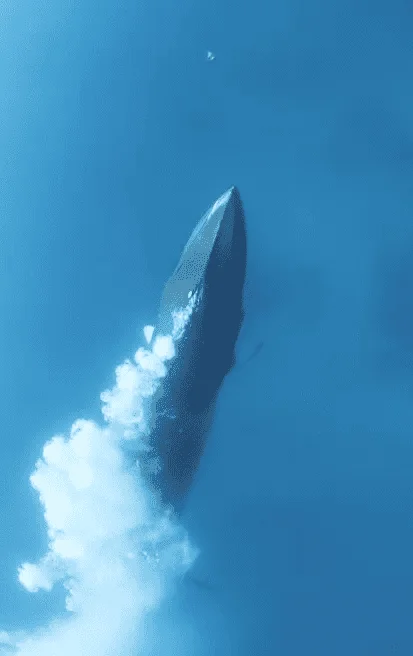
Gabriel Guzman (known as @underwater_images), a wildlife photographer, shot an underwater video of a minke whale. We can clearly see in this video (The Underwater Whale Snot) that this minke whale is trying to reach out upside down in the ocean.
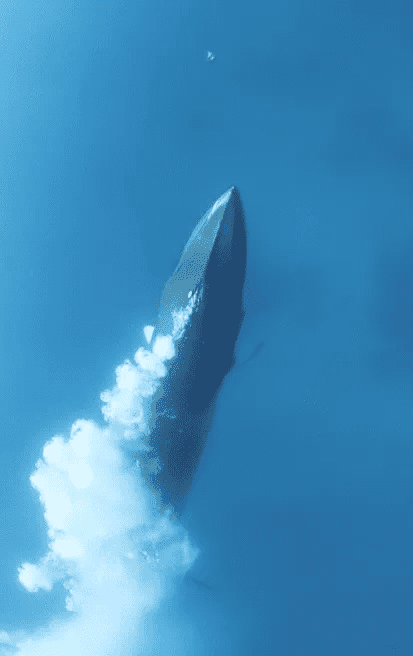
When he tries to do it, it seems like he is in a jacuzzi of bubbles, which came from these inquisitive and giant creatures a.k.a whale snot. He might be also hoping to get some jacuzzi time after shooting this video.
See: underwater.
See: underwater.
Underwater whale vocalizations, often called whale snot due to the distinctive spray produced when these marine mammals exhale, serve critical functions in long-distance communication, navigation, and social coordination across vast ocean distances where acoustic signals travel efficiently through water at speeds four times faster than through air. These remarkable cetacean species including humpback whales, blue whales, sperm whales, and orcas produce some of the loudest biological sounds in the ocean, reaching decibel levels that rival ship noise and industrial activities creating acoustic interference and masking effects that challenge whale communication abilities and force these marine mammals to adapt their vocalization strategies and communication patterns in response to increasing ocean noise pollution and anthropogenic stressors that threaten their ability to find mates, locate food sources, navigate migration routes, coordinate social behaviors with pod members, and maintain contact with distant relatives across ocean basins that span thousands of miles and require sophisticated sensory capabilities evolved over millions of years, highlighting the urgent need for international conservation efforts that address ship noise reduction through speed restrictions, shipping lane modifications, seasonal migration corridors, and marine protected area designation to preserve these incredible acoustic communication networks and the rich cultural traditions they represent, which carry vital information across generations through songs, calls, and vocal patterns passed down through maternal lines and social groups that form the foundation of whale society and individual identity within complex matriarchal societies where knowledge transfer occurs through patient teaching, gentle guidance, and protective behaviors that ensure calf survival and cultural continuity across decades through decades of careful observation, documentation, and advocacy by dedicated researchers, conservationists, and whale watchers who have witnessed firsthand the profound intelligence and emotional depth that characterizes these remarkable creatures and their interactions with each other and the vast ocean environment they call home.
Underwater whale vocalizations, often called whale snot due to the distinctive spray produced during exhalation, reveal complex communication networks that marine biologists study using advanced acoustic monitoring equipment deployed across global ocean basins. These vocalizations serve multiple functions including long-distance communication, navigation, social bonding, and mating behaviors that are particularly crucial for baleen whales like humpbacks and blue whales that migrate thousands of miles between feeding and breeding grounds each year. Scientists have documented distinct cultural dialects among different whale populations, suggesting learned vocal traditions passed down through generations that vary by geographic region and social group, providing evidence of complex social structures and cultural transmission that challenge traditional views of animal communication and intelligence through sophisticated acoustic behaviors that involve pattern recognition, vocal mimicry, and intergenerational knowledge transfer across vast oceanic distances where these remarkable marine mammals navigate using Earths magnetic field and acoustic landmarks while coordinating movements with pod members through sophisticated vocalizations that carry information about food location, threat detection, reproductive status, and social dynamics that facilitate long-term relationships and cooperative behaviors essential for survival in the challenging marine environment where these creatures have evolved over millions of years to thrive in ocean depths and surface waters alike through specialized physiological, physiological, and behavioral adaptations that enable them to regulate body temperature, conserve oxygen during deep dives, communicate across vast distances, and detect prey through echolocation and sensory systems that surpass human capabilities in many respects through the remarkable intelligence, emotional depth, and social complexity that characterize these gentle giants of the ocean and inspire wonder, respect, and commitment to their protection and conservation for future generations to study, appreciate, and learn from these incredible creatures that have inhabited Earths oceans for over 50 million years and continue to demonstrate the profound connection between all life on our planet.