Sunita Somvanshi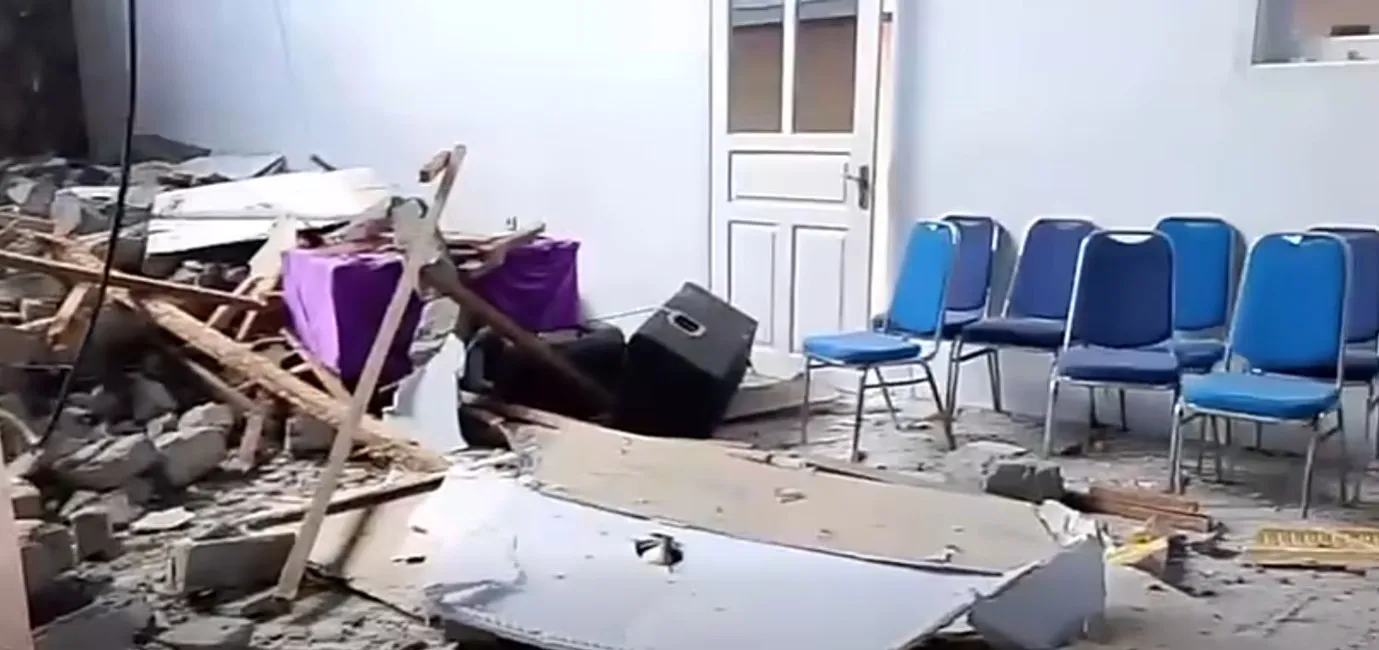
A powerful magnitude 7.7 earthquake struck off Indonesia’s Flores island on August 15, killing at least 20 people and triggering a tsunami warning that prompted residents to flee to higher ground. The quake struck at 21:58 UTC Saturday, about 68 kilometers northwest of Ende in East Nusa Tenggara province, according to the US Geological Survey.
The earthquake caused widespread damage across Flores, Manggarai, and Sikka regencies. Buildings collapsed, roads were blocked by landslides, and critical infrastructure suffered significant damage. The Indonesian National Agency for Disaster Management (BMKG) confirmed at least 20 fatalities and dozens of injuries.
The disaster triggered an initial tsunami warning within minutes, which regional authorities took seriously. Residents in coastal areas rushed inland as waves up to three meters slammed into beaches. After two hours of monitoring, authorities cancelled the warning, but the immediate response highlighted the region’s vulnerability.
“This is the kind of earthquake that leaves communities completely unprepared,” said Dr. Iwan Setiawan, a seismologist at Bandai Institut Teknologi Bandung. “The 1992 M7.8 earthquake in the same region killed 2,500 people. We’ve learned lessons, but implementation remains uneven.”
The quake’s epicenter lies along the Sunda Trench, where the Indo-Australian plate converges with the Eurasian plate at approximately 69 millimeters per year. This tectonic activity makes the region one of the most seismically active areas globally. Since 1950, there have been 37 earthquakes of magnitude 6.0 or greater within 250 kilometers of this epicenter.
UNESCO World Heritage sites in nearby Lombok and Bali raised concerns about cultural preservation. The Sacred Rice Terraces of Tegallalang in Bali, a UNESCO site, sits approximately 500 kilometers from the epicenter but could face indirect impacts through tourism disruption.
International aid has begun arriving. Australia’s Department of Foreign Affairs and Trade confirmed deployment of emergency response teams. The ASEAN Coordination Center for Humanitarian Assistance is coordinating regional support.
Residents described chaotic scenes in Ende. “The ground started shaking and buildings swayed like trees,” said Maria Nursafira, a teacher who survived by taking shelter under her desk. “When it stopped, we saw people on rooftops crying. We don’t have enough blankets for everyone.”
The government declared a state of emergency in three regencies. Mobile phone networks were disrupted, and power outages affected thousands. BMKG warned that aftershocks, some potentially reaching magnitude 7.0, could continue for the coming week.