 Enayat Garg
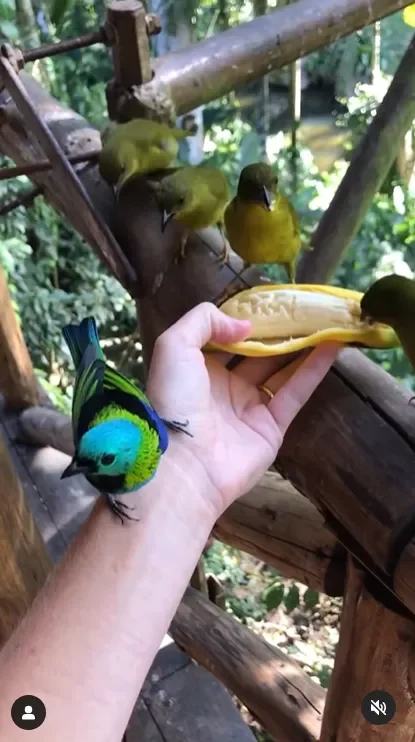
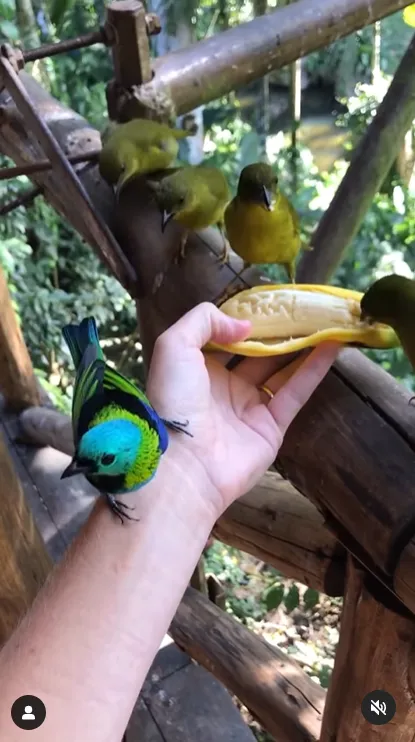
In the video by nebirds we can see how birds feed on a banana a flock of birds eating a banana from a human hand. This video is the beautiful epitome of how nature blends humans with animals.
The video is short in a Brazilian Atlantic forest . Nebirds is an Instagram page that showcases the Beauty in the world through a bird’s lens.
See: birds.
See: birds.
Birds feeding on bananas reveals fascinating aspects of frugivorous foraging behavior where these colorful tropical fruits provide energy-dense nutrition that supports migration, breeding, and territorial activities. Banana plants produce clusters containing dozens of individual fruits that ripen sequentially over weeks, creating a sustained food source that attracts multiple bird species including toucans, motmots, tanagers, and aracaris that have evolved specialized beak shapes and digestive systems. The relationship between banana-eating birds and these plants represents a classic example of mutualistic coevolution where birds gain high-energy food resources while plants receive seed dispersal services. This partnership benefits numerous other species including insects, bats, and small mammals that consume fallen fruits and contribute to nutrient cycling in tropical forest ecosystems where competition for limited fruit resources drives the evolution of specialized feeding behaviors, territorial defense strategies, seasonal migration patterns, and complex social hierarchies among bird communities that depend on reliable food sources like banana plants for survival and reproductive success across generations.
The relationship between banana-eating birds and these plants represents a classic example of mutualistic coevolution where birds gain high-energy food resources while plants receive seed dispersal services. This partnership benefits numerous other species including insects, bats, and small mammals that consume fallen fruits and contribute to nutrient cycling in tropical forest ecosystems where competition for limited fruit resources drives the evolution of specialized feeding behaviors, territorial defense strategies, seasonal migration patterns, and complex social hierarchies among bird communities that depend on reliable food sources like banana plants for survival and reproductive success across generations. These ecological relationships demonstrate how individual species interactions scale up to influence entire ecosystem function and stability through cascading effects on plant reproduction rates, seedling establishment patterns, predator-prey dynamics, and nutrient distribution patterns that shape forest composition and biodiversity across tropical landscapes where human activities including deforestation, agricultural expansion, and climate change impacts threaten these delicate ecological relationships that took millions of years to develop and maintain.
Birds feeding on bananas demonstrates fascinating foraging behaviors that reveal mutualistic relationships between frugivorous species and tropical fruit trees. Various bird species including toucans, hornbills, and aracaris have evolved specialized beak shapes that allow them to access fruit flesh while avoiding toxic parts of the plant that contain natural defenses against herbivory and seed predation. These feeding interactions contribute to seed dispersal across tropical ecosystems where birds transport seeds away from parent trees to favorable germination sites.
The seasonal availability of banana fruits influences bird migration patterns and feeding site selection across tropical regions where these interactions shape plant community composition and forest regeneration processes through seed dispersal services that maintain biodiversity and ecosystem health. These mutualistic relationships represent coevolutionary partnerships between plants and birds that have developed over millions of years of shared evolutionary history, with fruits evolving attractive colors, sweet flavors, and accessible positions while birds developed specialized digestive systems that pass seeds intact while extracting nutritious pulp and gaining energy for flight and reproduction.