 Karmactive Team
We have heard many stories of animals saving their lives. Saving one’s life is a critical and involuntary act and it can get very intense in the wild.
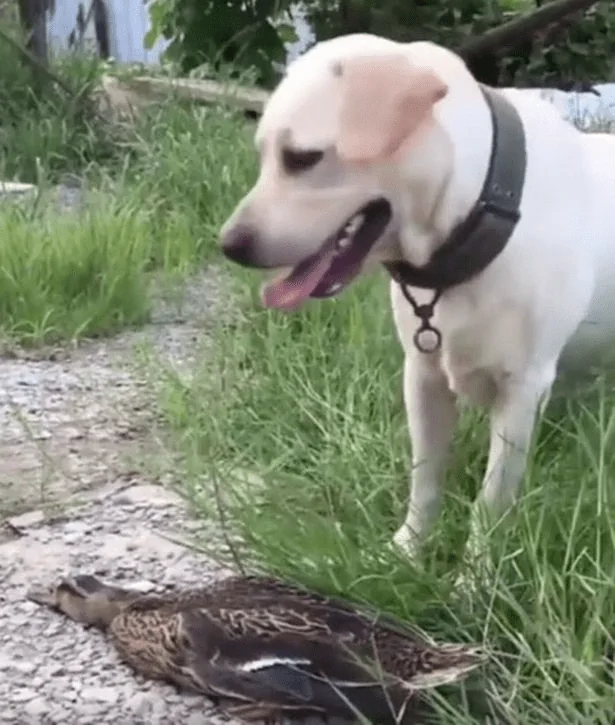
But very few times have we seen the use of acting to save one’s life. Well in this video a duck saves its life by playing dead in front of a dog. Check it yourselves what happens next.
Animal behavior researchers from the Cornell Lab of Ornithology have documented similar “playing dead” responses in multiple bird species as a survival mechanism when faced with predators.
The National Audubon Society notes that waterfowl like ducks employ various anti-predator strategies, including feigning death, erratic flight patterns, and distraction displays. These behaviors demonstrate cognitive complexity beyond simple instinct.
According to the International Ornithologists’ Union, over 30 bird species have been observed displaying thanatosis (clinical death-like state) as a defense mechanism. This behavior temporarily reduces metabolic activity and can confuse predators that rely on movement detection.
Wildlife documentary filmmakers emphasize that while these behaviors appear entertaining, they represent serious survival adaptations that have evolved over millions of years in wild bird populations.
Playing dead, or thanatosis, is an adaptive behavior where animals feign death to avoid predation. Research from the University of Bristol confirms that this strategy increases survival rates in prey species by temporarily disengaging predator attack responses that depend on detecting movement.
Documentary filmmakers note that capturing such rare behaviors requires patience of several weeks in the wild. These moments of apparent stillness reveal complex survival instincts that have evolved over millions of years of predator-prey relationships.