Rahul Somvanshi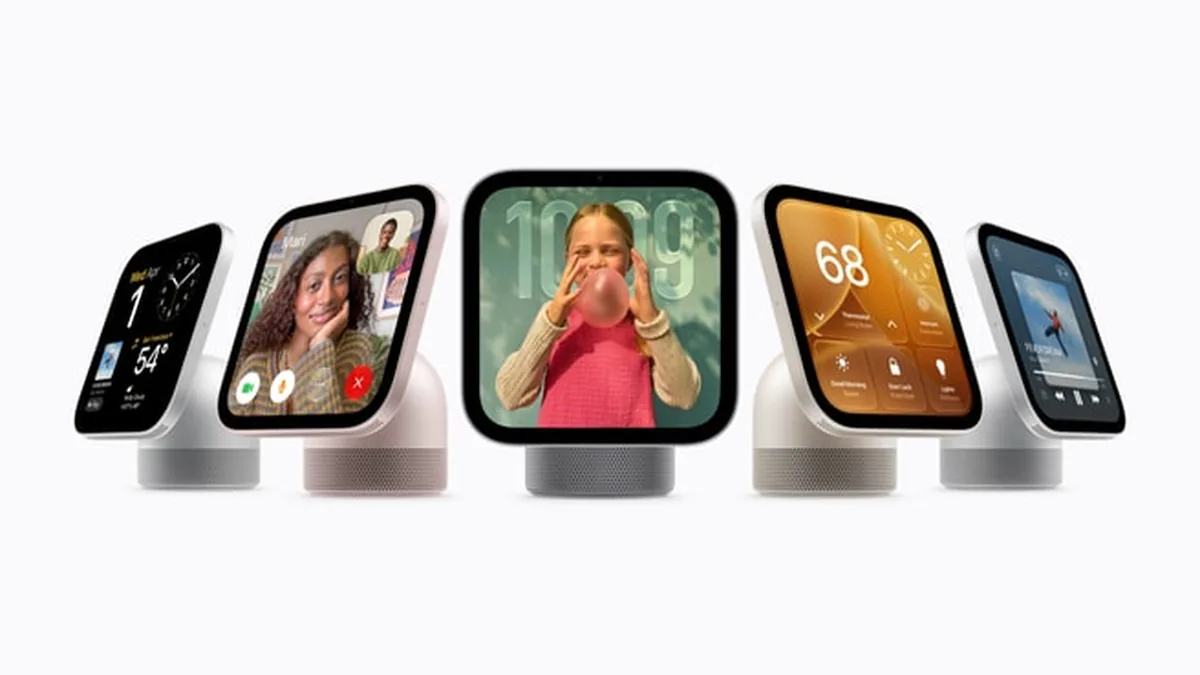
If you already have an iPad set up on your kitchen counter as a display, Apple's new $299 smart home screen will feel like a direct challenge to justify its own existence. HomeView launched October 13, 2026, with pre-orders opening the same morning—but the real question for most Apple households isn't what the device can do. It's whether a countertop iPad they already own does the same job for free.
Apple HomeView is a 7-inch square display with a 1,088×1,088 Liquid Retina screen at 220 pixels per inch, powered by the A18 chip. It pairs with a domed speaker base for countertop use. A wall-mounted model is also available at $299, but the required mounting hardware—a USB-C power connector starting at $59.95, or hardwired versions from $79.95—is sold separately; the cheapest complete wall installation costs $358.95 before tax. The device runs purpose-built home software and connects to smart home hardware through Thread and Matter protocols, serving as a Matter home hub. Built-in far-field microphones handle hands-free Siri requests. Pre-orders opened October 13, 2026, with units shipping and arriving in stores November 13, 2026. US, UK, and Australian markets are open simultaneously.
Smart home adopters, HomeKit users, and Apple ecosystem households face a concrete $299 purchasing trade-off rather than an urgent equipment upgrade. Families currently relying on an iPad in a countertop dock can replicate most dashboard functions without buying dedicated hardware. Before pre-ordering, homeowners should assess whether hands-free Siri AI interactions, facial profile switching, and dedicated Matter hub capabilities justify spending $300 on a stationary countertop screen.
What HomeView Does That an iPad Cannot
The technical advantage Apple is selling isn't the A18 processor or the square screen design. It's a passive facial sensor that automatically switches personalized calendars, reminders, and notes when different family members walk past the display. Automatic household personalization—detecting each person by face and displaying their own content without any tap or unlock—has not been available on an iPad in countertop use. HomeView supports up to six household members, with personal content appearing only when the right person is recognized and a recently unlocked paired iPhone or iPad is nearby.
Apple processes the device's camera and microphone data in Secure Exclaves isolated from the operating system; however, Siri requests may be handled on-device or through Apple's Private Cloud Compute depending on the task.
HomeView connects to smart home devices through Thread and Matter as a compatible home hub for Apple's Home app.
HomeView does not have an on-device App Store. There is no way to download apps directly to the device. Compatible third-party audio apps—including Spotify and Audible—and iOS video apps that developers extend to HomeView are available through a connected iPhone or iPad. Some features require a compatible iPhone to be nearby and recently unlocked.
Amazon's Echo Show and Google's Nest Hub have owned the countertop display category for years—HomeView enters late but with tighter integration across the Apple device ecosystem. Whether that integration justifies $299 over a countertop iPad depends on whether your household needs hands-free facial personalization.
For hardware comparisons with competing smart displays and Apple's broader smart home product line, the gap HomeView most clearly closes is multi-user household identity, not raw functionality. For a breakdown of the Matter protocol and home hub compatibility, HomeView fits the same role as an Apple TV 4K or HomePod in managing automations.
How much is Apple HomeView and when does it come out?
Apple HomeView is priced at $299 in the United States for both the countertop speaker base and wall-mounted models. Pre-orders opened on October 13, 2026, immediately following Apple's product announcement, with initial deliveries and in-store retail availability beginning nationwide on November 13, 2026.
Can Apple HomeView download regular iPad apps?
HomeView does not have an on-device App Store, so apps cannot be downloaded directly to the device. Compatible third-party audio apps including Spotify and Audible, and iOS video apps extended by developers, are accessible through a connected iPhone or iPad. Some features require a compatible iPhone nearby.
What is the difference between Apple HomeView and an iPad?
HomeView's primary distinction is automatic multi-user household personalization—detecting each family member by face and showing their own calendar, notes, and reminders without any tap required, a feature not available when using an iPad as a countertop display. HomeView also serves as a Matter home hub. An iPad in a countertop dock can replicate most visual dashboard displays but shows only one person's content.
HomeView ships to pre-order customers on November 13, 2026, when retail stores in the US, UK, and Australia also receive stock. The hands-on reviews from that day will test whether facial profile switching and HomeView's home software hold up to daily kitchen use across large families. Check back in November for coverage of early shipping units and user reports.