 Sonali Tiwary
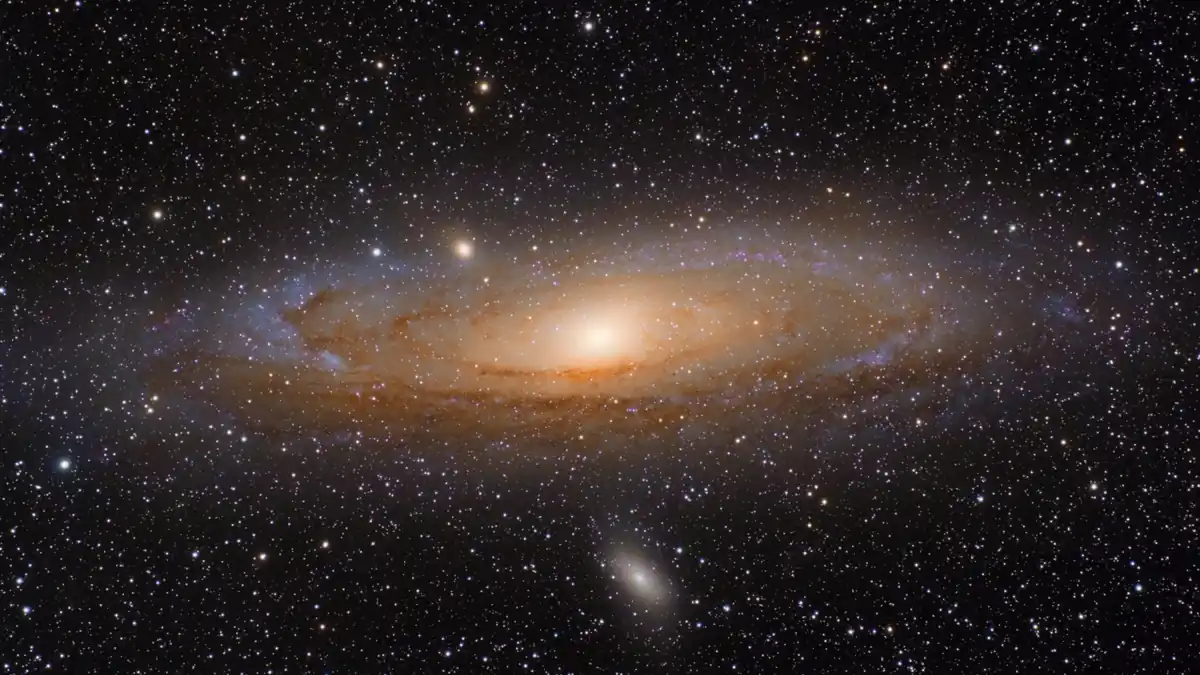
For the first time in history, astronomers have directly observed frictional-drag energy dissipation inside a common envelope event — capturing the physical signature of a red giant consuming its binary companion as the process unfolded, delivering empirical proof of a stellar death sequence predicted for decades.
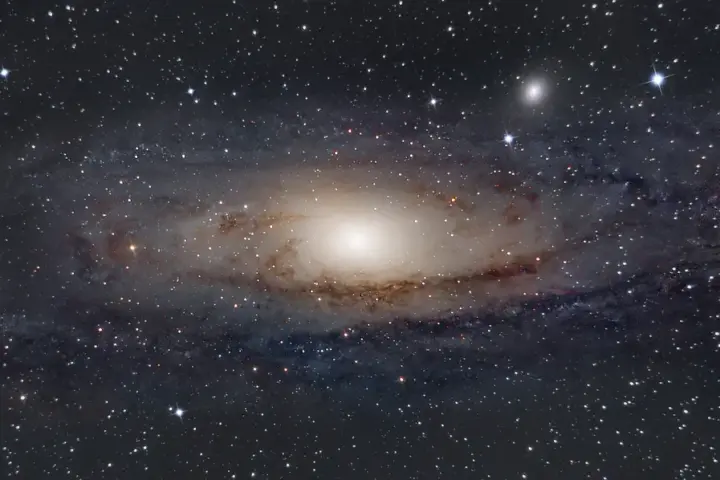
The discovery, published in Nature (vol. 659, pp. 628–633, 18 Nov 2026; DOI: 10.1038/s41586-026-11221-z), centers on a stellar system nicknamed “Big Bao,” located approximately 2.5 million light-years away in the Andromeda Galaxy. Lead author Viraj Karambelkar and colleagues documented the system undergoing common envelope evolution (CEE) — a process where a swelling red giant engulfs a smaller companion star, the two briefly sharing a surrounding gas cocoon before a catastrophic final merger. The primary star — roughly 7 solar masses, some 350 times the Sun’s radius, and approximately 18,000 times more luminous than our Sun — overwhelmed its companion, a star of about 0.7 solar masses, completing the merger in fewer than ten orbits.
What Is a Common Envelope Event?
When a massive star exhausts the hydrogen in its core, it expands into a red giant. If a smaller companion orbits close enough, the giant’s outer layers gradually engulf it. The two stars then spiral inward together, shedding enormous quantities of gas and energy in a process that ends in a complete stellar merger and a terminal explosion called a luminous red nova — brighter than a standard nova but far dimmer than a supernova. Astrophysicists had predicted this sequence for decades. Big Bao delivered the first clean, real-time empirical proof that the prediction was correct.
Seven Years of Pre-Eruption Signs
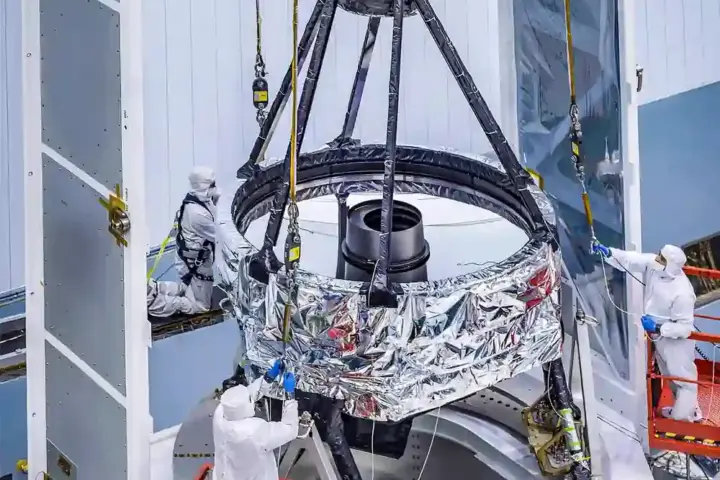
The most remarkable finding wasn’t the explosion itself. Archival infrared data from NASA’s NEOWISE space telescope revealed that Big Bao’s red giant had already begun expanding and dimming in optical wavelengths a full seven years before the luminous red nova outburst occurred. That slow pre-merger fading — invisible in contemporaneous optical surveys but preserved in NEOWISE’s infrared archive — is now a confirmed precursor fingerprint. Future sky surveys can use it to identify other systems approaching the same fate before the final catastrophic event, transforming a one-off discovery into a systematic detection template. The James Webb Space Telescope later trained its instruments on the aftermath, observing the remnant just 47 days after the eruption peaked and revealing the cooling ejecta in unprecedented infrared detail.
Earth’s Preview, Five Billion Years Early
Big Bao is not merely an astronomical spectacle. It is a dress rehearsal for the eventual fate of our own solar system.
In roughly five billion years, our Sun will swell into a red giant and engulf Mercury, Venus, and almost certainly Earth. Until now, planetary scientists and astrophysicists had no direct observational data to anchor their models of that process. The Big Bao findings provide the missing empirical calibration — closing a decades-long theoretical debate about CEE dynamics and delivering an exact observational blueprint for what the inner solar system will one day face. For stargazers and scientists alike, it is unprecedented real-time proof of how dying stars consume their binary systems.
The implications extend further still. Tight binary systems that survive common-envelope events are leading candidates for the neutron star and black hole mergers that LIGO and Virgo were built to detect, meaning Big Bao directly sharpens gravitational-wave predictions.
Stellar Forensics, Supercharged by Archives
Big Bao was partly unlocked by the sheer depth of modern sky-survey archives. As AI-driven astronomy pipelines push detection accuracy toward 93 percent, the ability to mine years of multi-wavelength archival data for pre-eruption signatures will only sharpen — converting rare cosmic violence from a matter of luck into a tractable, predictive science.
The universe’s most catastrophic moments, it turns out, leave a paper trail years long.