Sunita Somvanshi
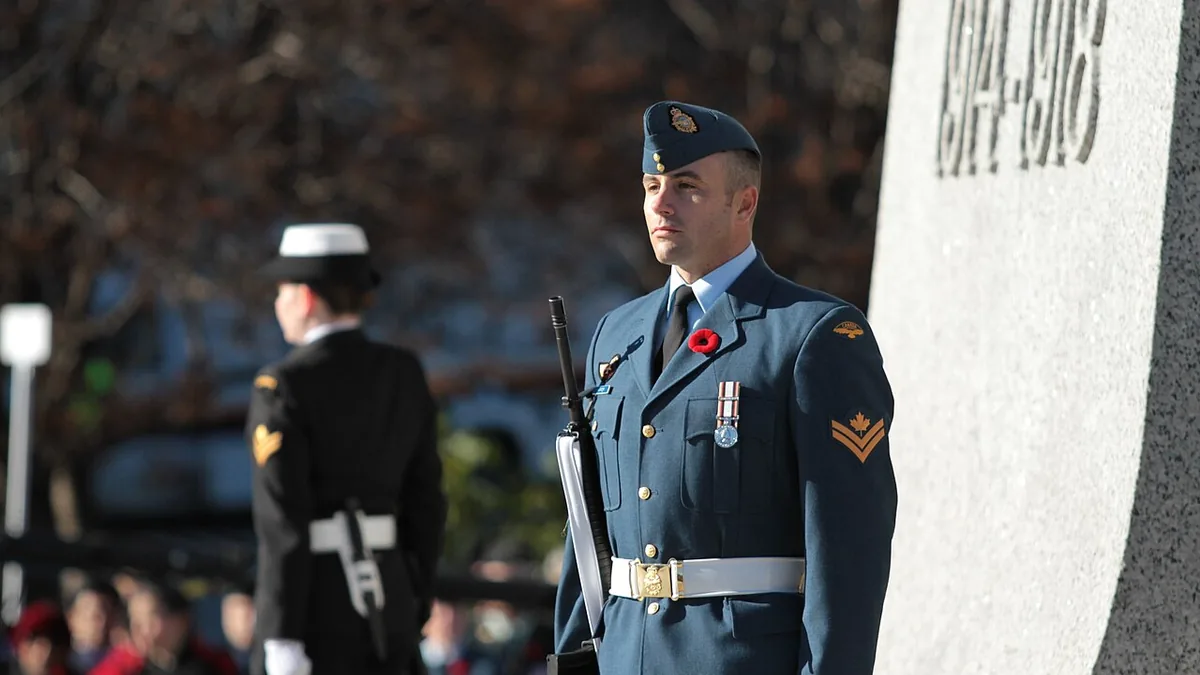
As Canadians gathered at the Remembrance Day ceremony in Ottawa on November 11, the woman laying the wreath on behalf of every mother who lost a child in military service carries a story that took seven years to be officially recognized — just weeks after four more soldiers died in a fire during a live-fire training exercise of their own.
Virginia Hicks of Frankford, Ontario, was named the Royal Canadian Legion’s 2026 National Silver Cross Mother and laid a wreath at the National War Memorial that morning. Her daughter, Sapper Mariebeth Short of 2 Combat Engineer Regiment, died on September 23, 2002, at age 22, when her light armoured vehicle rolled over on the Mattawa Plains at CFB Petawawa — a crash investigators later attributed to a manufacturing defect in the vehicle’s wheel assembly. Hicks herself served nearly 29 years in the Canadian Army, retiring from the regular forces in 2008 after service that took her to the Persian Gulf, Afghanistan, and Italy, and continued as a reservist until 2017.
For Canadian Armed Forces families — including loved ones of the four soldiers killed in last month’s CFB Wainwright training fire — Hicks’s appointment confirms that domestic training deaths carry the same national recognition as combat deaths overseas. Under federal rules made retroactive to October 7, 2001, a Canadian Armed Forces member may designate up to three people to receive the Memorial Cross, plus up to five additional people — who are not already receiving the Cross — to receive the related Memorial Ribbon. Veterans released on or after October 7, 2001 who filed a designation while still serving must complete a new form with Veterans Affairs Canada to keep that designation valid.
How Sapper Mariebeth Short’s Legacy Reaches From Petawawa to CFB Wainwright
At 4 feet 11 inches and roughly 95 pounds, Short had tested a specialized small-stature bomb-disposal suit at Petawawa whose data the military still uses today. Hicks herself returns to the Petawawa crash site every year and visits her daughter’s grave in Trenton several times a month.
A Seven-Year Wait for Recognition
Though her daughter died in 2002, Hicks wasn’t presented with the Memorial Cross until 2009, because the rules at the time limited the medal to deaths in overseas special duty areas and restricted recipients to mothers and widows. Hicks has said she had believed the medal was only for families of those killed overseas, and was surprised to learn it also covers training and work-related deaths at home. Rule changes made in 2007 and 2008, retroactive to October 7, 2001, extended eligibility to all service-related deaths, including training deaths in Canada — which is what made Short’s death eligible.
Who is eligible to receive the Memorial Cross (Silver Cross) in Canada?
Since rule changes made retroactive to October 7, 2001, the Memorial Cross is awarded for any Canadian Armed Forces death attributed to military duty, including domestic training accidents. A member can designate up to three family members or loved ones to receive the Cross, plus up to five additional people for the related Memorial Ribbon, provided those five are not already designated to receive the Cross itself.
Hicks’s term runs through October 31, 2027, and the military’s investigation into the CFB Wainwright training fire that killed four soldiers last month remains ongoing.