 Govind Tekale
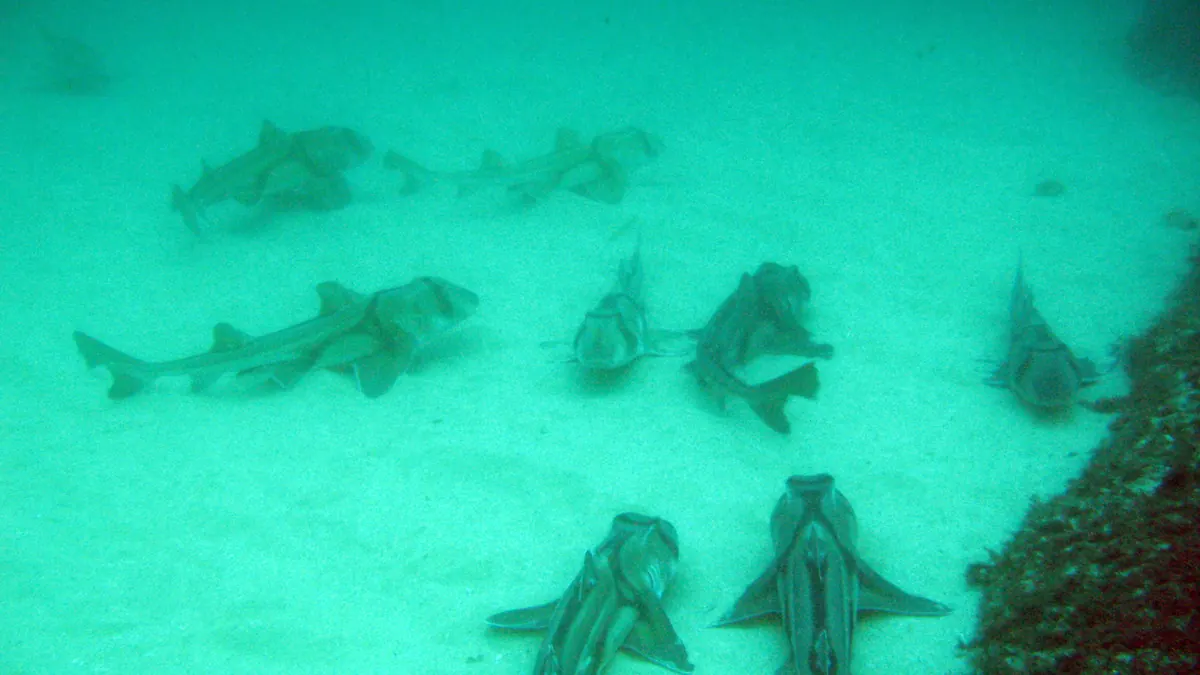
An underwater robot was mapping the deep seafloor inside Bass Strait’s Beagle Marine Park when it came across something researchers had last seen six years earlier: the same general area, the same 65-metre depth, and around 1,000 Port Jackson sharks—mostly female—packed together like a carpet on the bottom.
The footage was captured by a seven-camera Boxfish Robotics ROV deployed from the SARDI research vessel MRV Ngerin, as part of a University of Tasmania Institute for Marine and Antarctic Studies (IMAS) and Parks Australia survey of Beagle Marine Park. Voyage leader Dr. Jacquomo Monk of IMAS confirmed the team found two aggregations of roughly 1,000 Port Jackson sharks—Heterodontus portusjacksoni—resting motionless on mid-depth reef ledges at around 65 metres, and that the sharks were mainly female. The survey, first released by NESP Marine and Coastal Hub in August 2024, catalogued species at the 50–70-metre reefs to help Parks Australia assess the effectiveness of its marine park conservation zones.
Unlike great white sharks and other species that must keep moving to breathe, Port Jackson sharks use buccal pumping—actively drawing water across their gills while stationary—which allows them to rest motionless on the seafloor. According to the IMAS research team, researchers believe the females gather at this site to rest and possibly feed before migrating to coastal areas where they lay their distinctive corkscrew-spiral egg cases; the exact reason for the aggregation has not been definitively established. Finding mainly female Port Jackson sharks in almost the same location twice, six years apart, at 65 metres depth inside Beagle Marine Park, suggests this site may be a recurring aggregation area. Two observations suggest possible site fidelity; further surveys would be needed to confirm whether this is a reliable, recurring gathering ground. These findings are the kind of site-specific data that marine park management in Bass Strait and southern Australia can use to prioritise which seafloor areas to protect.
The IMAS team embedded underwater video of the aggregation in its NESP release. Parks Australia’s ongoing biomonitoring of Australia’s Marine Parks network is expected to continue in coming years.