Karmactive Team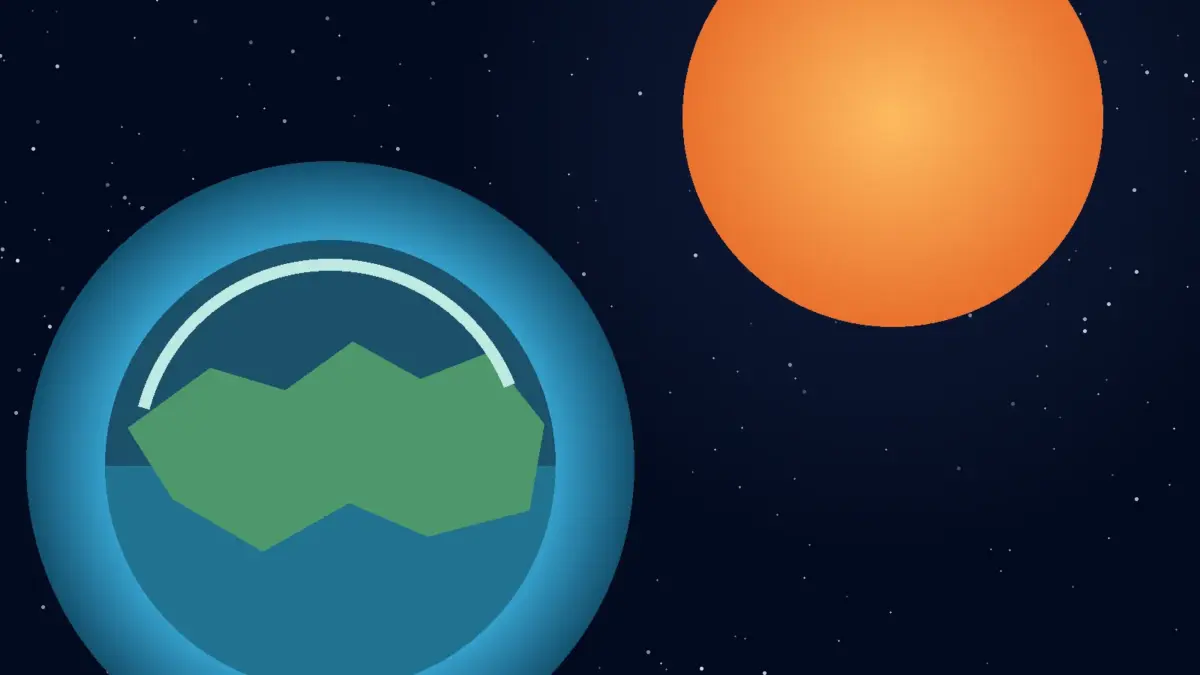
Could a planet be more hospitable to life than Earth? It is a serious scientific question, but recent headlines go further than the evidence. No “superhabitable” planet has been found to host life, and no study has shown that another world is better than Earth for life.
The idea comes from a 2020 Astrobiology paper that proposed characteristics astronomers might prioritise when searching for potentially life-friendly exoplanets. Its authors explicitly did not assume that the candidate worlds host life. “Superhabitable” is a hypothesis for choosing observation targets, not a label earned by a confirmed living planet.
One proposed advantage is an orbit around a K-dwarf star. These orange stars are cooler than the Sun and can remain stable for a long time. That may give a suitable planet more time in which life could develop, but it does not establish that life has developed there.
What the plant experiment actually found
A separate experiment helped test one narrow part of the question: whether familiar photosynthetic organisms could use light with a K-dwarf-like spectrum. Researchers grew garden cress and cyanobacteria under simulated illumination. The peer-reviewed study found significant photosynthesis under the simulated light; the reported garden-cress growth and photosynthetic efficiency were comparable with solar-light conditions.
That result does not show that leaves would grow faster on an exoplanet, nor does it test a complete alien environment. A real planet’s habitability also depends on its atmosphere, water, chemistry, geology, radiation environment and climate. The experiment used Earth organisms in controlled conditions, rather than observing life beyond Earth.
Are “super-Earths” better than Earth for life? Scientists do not know. “Super-Earth” usually refers to an exoplanet larger than Earth but smaller than Neptune; it does not mean the planet is confirmed to be habitable. The superhabitability proposal identifies possible targets for follow-up, while the K-dwarf experiment shows that some Earth photosynthesis can function under a simulated stellar spectrum.
The useful takeaway is narrower than the headlines: Earth is not the only environment scientists can model as potentially suitable for life. But evidence of life beyond Earth—and evidence that any world is better for it—has not yet been found.