 Govind Tekale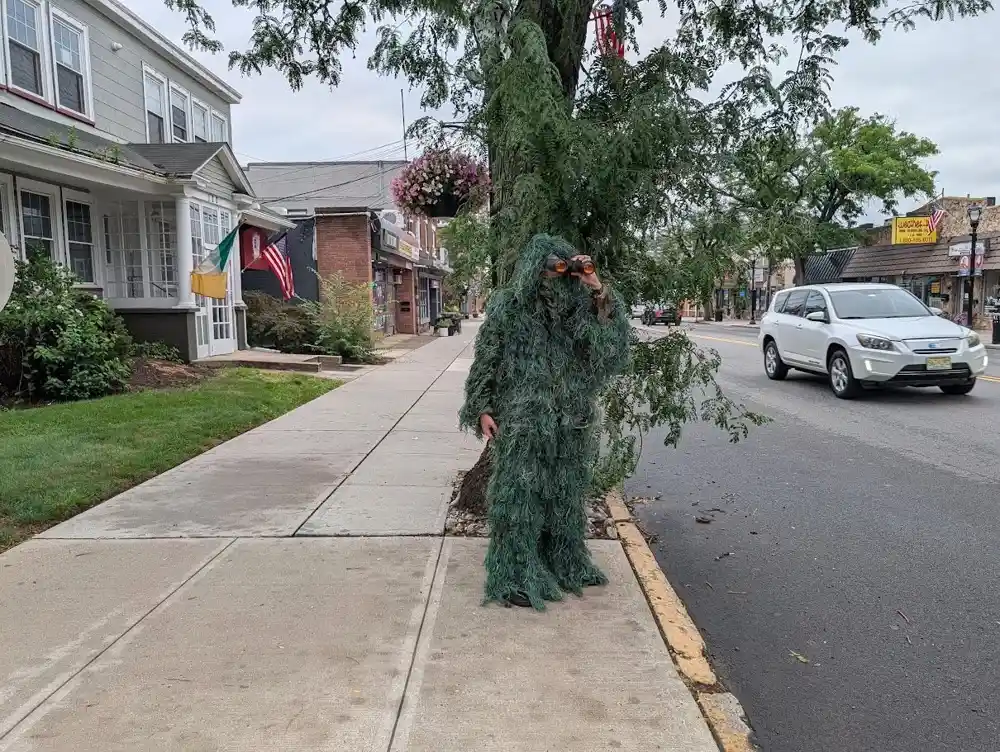
A Dunellen police officer dressed as a shrub caught 74 drivers on their phones in a single six-hour shift. The viral image of a ghillie-suited officer with binoculars drew social media attention, but the real story is what the data reveals about distracted driving enforcement effectiveness.
Wednesday’s operation on the 100 block of North Washington Avenue in Dunellen, New Jersey targeted a stretch of downtown the department had flagged as high-traffic and pedestrian-heavy. This location experiences a disproportionate number of accidents tied to distracted driving.
The department’s social media post became famous: “Did you spot our ‘shrub’ today? If you had your head buried in your phone, probably not!” The humor masked a serious enforcement strategy. Detective Sergeant Nicholas Goldman later clarified that the ghillie suit was primarily a public outreach tactic used for social media engagement rather than the entire enforcement detail. The creative visual drew attention to a real safety problem.
The actual operation worked differently. One officer used the shrub costume for limited periods and observation. A second officer, wearing a shirt that read “Not a Cop,” positioned himself to relay driver information to intercept teams stationed down the street. This dual-layer approach—observation and intervention—mimicked high-visibility enforcement (HVE) tactics that research shows actually work to reduce dangerous driving.
The numbers speak to distracted driving’s scale. At any given daylight moment, approximately 660,000 drivers nationwide are using handheld phones while driving. Phone-related distraction is involved in roughly 1 in 4 crashes. NHTSA data for 2024 shows 3,208 people died in distraction-affected crashes, with 315,167 injured. That’s approximately 8.7 deaths every single day from distracted driving alone.
Texting is the most dangerous form of distraction. Experimental studies show texting drivers spend up to 400% more time looking away from the road compared to undistracted driving. At 55 mph, a five-second phone glance covers the length of a football field entirely blind. The Institute of Highway Safety has found that hands-free phone use offers little to no safety advantage over handheld—the cognitive distraction persists even when your hands stay on the wheel.
New Jersey’s Handheld Cell Phone Law makes it illegal to hold, touch, talk on, or text using a mobile device while driving. First-time offenders face fines of $200 to $400. Subsequent violations escalate: second offense reaches $400–$600, third offense climbs to $600–$800 with potential 90-day license suspension.
Dunellen traffic safety patrolman Kevin Condis described what officers are seeing. “We’re seeing a lot of people just holding their phones, following either a GPS or FaceTime. We did see unfortunately a lot of people holding the phone with two hands and like almost driving with their knees, which sounds crazy, but you know, there’s a lot of people that were doing it.”
Research on HVE programs shows why Dunellen’s approach works. In Hartford, Connecticut, a high-visibility enforcement program produced a 57% drop in handheld phone use among drivers. Syracuse achieved 32% reduction. The key factor: primary enforcement laws, where police can pull someone over specifically for phone use without needing another traffic violation, produce faster crash reductions than secondary enforcement approaches.
Dunellen’s 74 citations in six hours represents potential life-saving enforcement. If even 20% of those drivers modify their behavior going forward, you’re preventing crashes that could involve injuries or fatalities.
The shrub may have gone viral, but the real message was straightforward: distracted driving enforcement works, saves lives, and communities willing to prioritize it see measurable safety improvements. See how communities are building safer infrastructure.