Chris Bosh Says He Woke Up “Covered in My Own Blood” — and Now Sees Life Differently
The NBA Hall of Famer described blacking out with no warning before a date night with his wife. He has a history of blood clots that ended his playing career. Here is what he said, what we know, and what it means for anyone living with similar health risks.
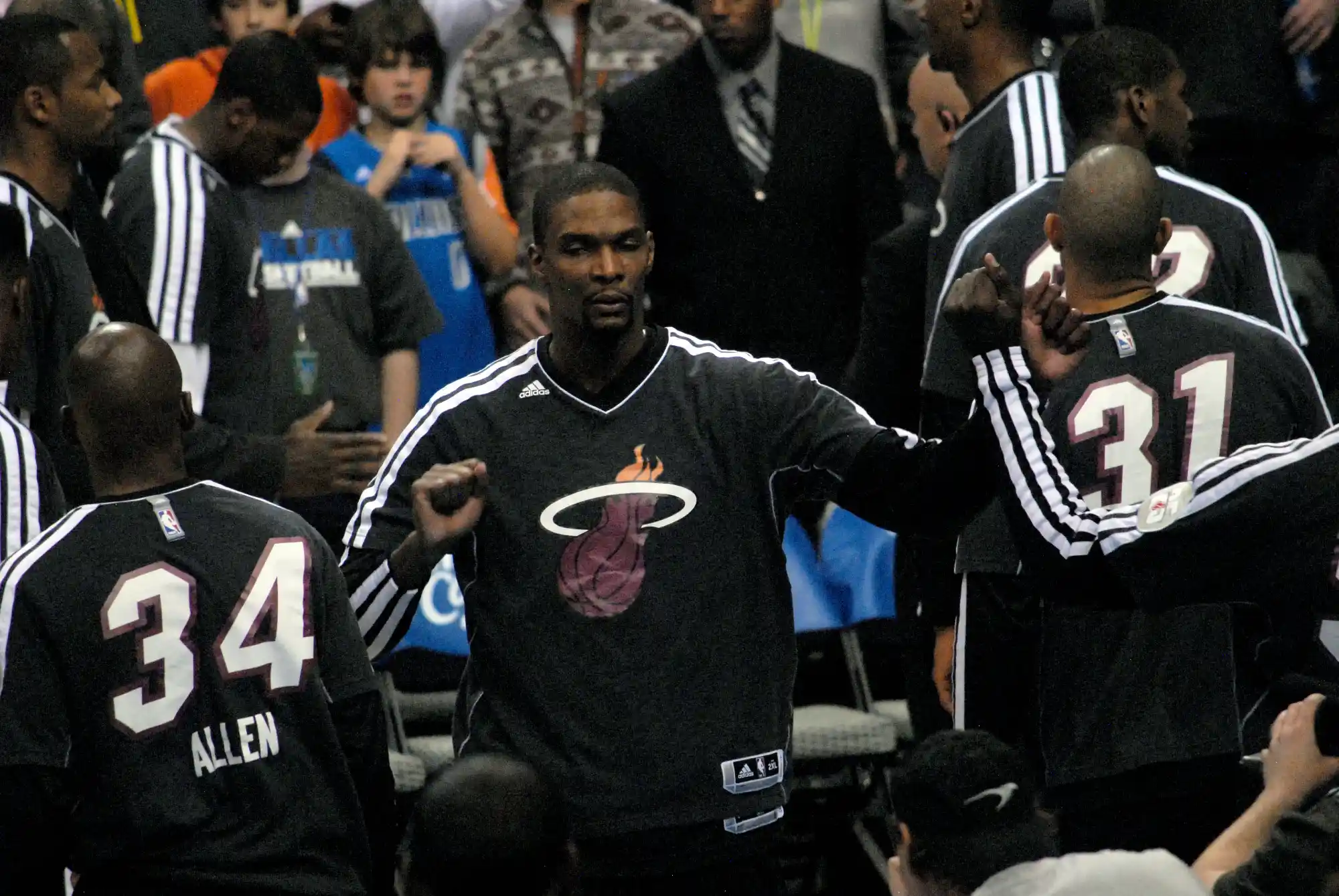
Chris Bosh greets teammates during a Miami Heat pregame introduction in December 2012 — years before the blood-clot complications that altered his career. Photo: Scott Mecum via Flickr — CC BY 2.0
NBA Hall of Famer Chris Bosh shared a first-person account of a sudden medical emergency in a Substack post titled Return From the Darkness, published on February 22, 2026, and followed by a video on his official Instagram account. The 41-year-old, who won two NBA titles with the Miami Heat and was inducted into the Naismith Memorial Basketball Hall of Fame in 2021, described losing consciousness with no prior warning and waking up covered in blood while his wife was on the phone with 911.
Bosh has a documented history of venous thromboembolism (VTE) — including a pulmonary embolism in 2015 and recurrent deep vein thrombosis in 2016 — that led to the NBA and NBPA ruling his condition career-ending. He did not disclose a formal medical diagnosis for this 2026 incident, and neither he nor his representatives have issued a clinical statement as of publication. His public message, however, was direct: “Don’t wait.”
“I woke up covered in my own blood. It was crazy. It was fast. It was instant. There was no warning. I didn’t have any time to prepare for it.”
— Chris Bosh, Instagram video, February 2026Bosh wrote in his Substack that “a numbing sensation shot down my left leg” before he fell. He regained consciousness to find himself unable to move, in a pool of blood, with his wife frantically speaking to emergency services. The area around his eyes showed visible bruising in the video, which Bosh acknowledged without elaborating on the cause.
A Career and a Health History, in Order
Tap each milestone to expand the detail.
Tap any milestone to expand
On his Substack newsletter The Last Chip, Bosh wrote a detailed personal account. “That’s when the realization hit me,” he wrote, “everything can collapse at a moment’s notice. There’s not always a warning. There’s not always a symptom or a buildup to let you know what’s coming. One moment you’re walking. The next moment, you could be gone.”
In the follow-up Instagram video, visible bruising around his eyes was noticeable — physical marks he acknowledged without specifying their cause. “I won’t get into specifics,” he said, “but you can kind of see I’m still recovering. I’m not gonna try to hide that one in case I look different.”
“After coming back from the darkness, there was no euphoric clarity. No life montage flashing before my eyes. Just the gratitude for still being alive and a newfound, sobering awareness of how everything actually is.”
— Chris Bosh, Substack post, February 22, 2026He also wrote: “I stopped paying attention to things outside of myself and started paying attention to the things I had neglected. I began to focus on the passions and people who were already pouring into my life, rather than chasing validation from the unknowns.”
Bosh’s account does not include a clinical diagnosis or any statement about whether his 2026 incident is linked to his prior blood-clot history. No hospital statement or medical representative comment has been published. Outlets attributing a cause are speculating. The primary, verified source remains his own Substack and Instagram posts.
Blood Clots: What the Data Says
Factual information on VTE — sourced from the CDC and BMJ. Not specific to Bosh’s 2026 incident.
The CDC lists these as common warning signs of venous thromboembolism. These apply to both deep vein thrombosis (DVT) and pulmonary embolism (PE).
Data on recurrence and treatment outcomes for patients with a history of VTE, per BMJ research (Nov 2025) and CDC population estimates.
Sources: The BMJ (Nov 2025) · CDC Blood Clots Overview
Per the CDC’s VTE risk guidance, seek immediate emergency care if any of the following occur.
Source: CDC — Know the Risks, Signs & Symptoms of Blood Clots
The NBA Medical Ruling
When blood clots recurred in Bosh in 2016, the Miami Heat and the NBA placed him on the injured list after he failed his training-camp physical on September 23, 2016. A joint review panel of the NBA and National Basketball Players Association subsequently ruled that Bosh’s health condition made it unsafe for him to continue playing professional basketball. This ruling came into effect in 2017. Bosh continued attempting a comeback until officially retiring in 2019.
For athletes managing chronic VTE conditions, the long-term management involves Direct Oral Anticoagulants (DOACs), regular monitoring, and structured lifestyle adjustments. A known complication of long-term anticoagulation is that even minor trauma — such as a fall during a blackout — can result in disproportionate blood loss, which may contextualise the scene Bosh described upon regaining consciousness.
Bosh has not confirmed whether he is currently on blood-thinning medication or whether his prior clot history is clinically related to this 2026 event. His own posts remain the only verified first-hand account.
The incident has prompted public acknowledgement from former teammates and peers. Dwyane Wade and Gabrielle Union shared messages of support. Nate Robinson, who has faced his own publicised health challenges, and NBA stars including Kevin Durant and Dwight Howard commented publicly on Bosh’s Instagram post.
Chris Bosh — Career at a Glance
Bosh left the Raptors in 2010 as their all-time leader in points, rebounds, blocks, and minutes played. Stats verified via NBA official stats · Naismith Hall of Fame profile.
Chris Bosh’s Substack account and Instagram video were covered here — his description of sudden leg numbness, a blackout, waking up in a pool of blood, and his wife contacting 911. His prior history with pulmonary embolism (2015) and recurrent DVT (2016) — which led to a joint NBA/NBPA medical ruling — was reviewed. His career with the Toronto Raptors and Miami Heat, culminating in his 2021 Hall of Fame induction, was also outlined. No formal diagnosis for the February 2026 event has been publicly disclosed by Bosh or his representatives. His message to the public, drawn directly from his own words: “Don’t wait.”
For general guidance on blood clot symptoms and emergency warning signs, the CDC’s VTE information pages offer factual, evidence-based information. Anyone experiencing sudden fainting, unexplained leg pain, difficulty breathing, or chest pain is advised to seek immediate medical attention.