 Rahul Somvanshi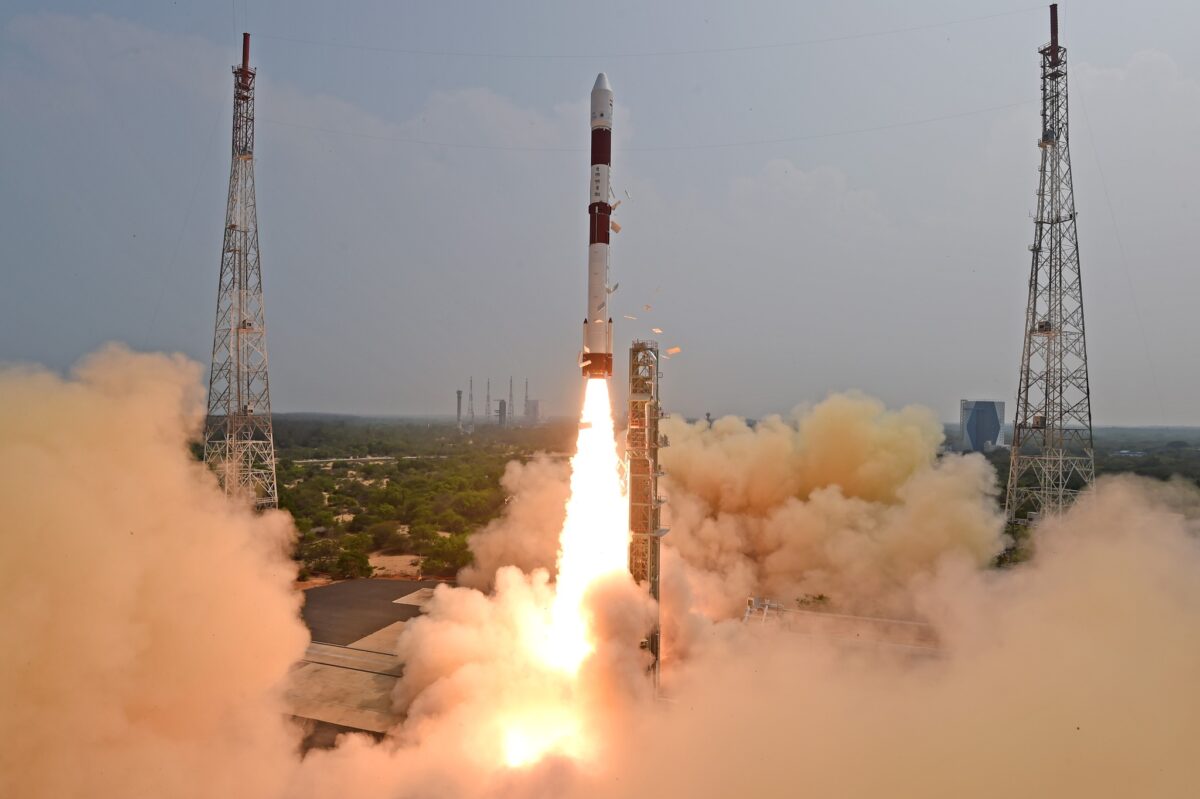
An Indian rocket developed by ISRO launched two Singaporean satellites into low Earth orbit on April 22nd. ISRO’s Polar Satellite Launch Vehicle (PSLV) took off from India’s Satish Dhawan Space Centre carrying an Earth-observation satellite and a communications tech-demonstrating craft. The rocket deployed the two spacecraft as planned about 20 minutes after launch.
The vehicle placed TeLEOS-2 and LUMELITE-4 satellites precisely into their intended 586 km circular orbit in a textbook launch, according to ISRO. India’s launch marked the 57th flight of PSLV and the 16th mission using the PSLV Core Alone configuration, the lightest version of the launch vehicle as it has four core stages and no strap-on boosters to provide an added thrust.
TeLEOS-2, developed under a partnership between Singapore’s Defence Science and Technology Agency and ST Engineering. TeLEOS-2 will support the satellite imagery requirements of various agencies in Singapore. TeLEOS-2 carries a Synthetic Aperture Radar (SAR) payload, providing all-weather day and night coverage.
LUMELITE-4, co-developed by the Institute for Infocomm Research of A*STAR and the Satellite Technology and Research Centre of the National University of Singapore. LUMELITE-4 aims to augment Singapore’s electronic navigation maritime safety systems. The PSLV Orbital Experimental Module had seven non-separating payloads for scientific experiments.
The main payload for the PSLV was TeLEOS-2, an Earth-observation satellite that will collect imagery data for the government of Singapore. TeLEOS-2 is capable of resolving features on the ground as small as 3.3 feet (1 m). LUMELITE-4 aims to demonstrate a new data-exchange system, that is designed to “augment Singapore’s e-navigation maritime safety and benefit the global shipping community”.
Going further, India’s first uncrewed Geosynchronous Satellite Launch Vehicle (GSLV) rocket is expected to be launched in February 2024 as part of the Gaganyaan mission. ISRO’s Gaganyaan project envisages the demonstration of human space flight capability by launching a crew of three members to an orbit of 400km for a three-day mission and bringing them safely back to earth by landing in Indian sea waters.
- 5 Laptop Bags That Make Monday Mornings in the Office Worth It
- What are the Most Elegant Ladies’ Gold Chain Styles You Can Try This Year?
- Just 1 Percent of This Plastic Ever Got Recycled — Until a 90-Job Indonesian Plant Changed That
- 101 Dead in Spain, 62,000 Across Europe in 2024: WHO Urged to Declare Climate Change a Health Emergency
- All-Perovskite Solar Hits 30.3% Certified — Zero Silicon, 28% Flexible, and 92% Stable After 1,000 Hours