 Sonali Tiwary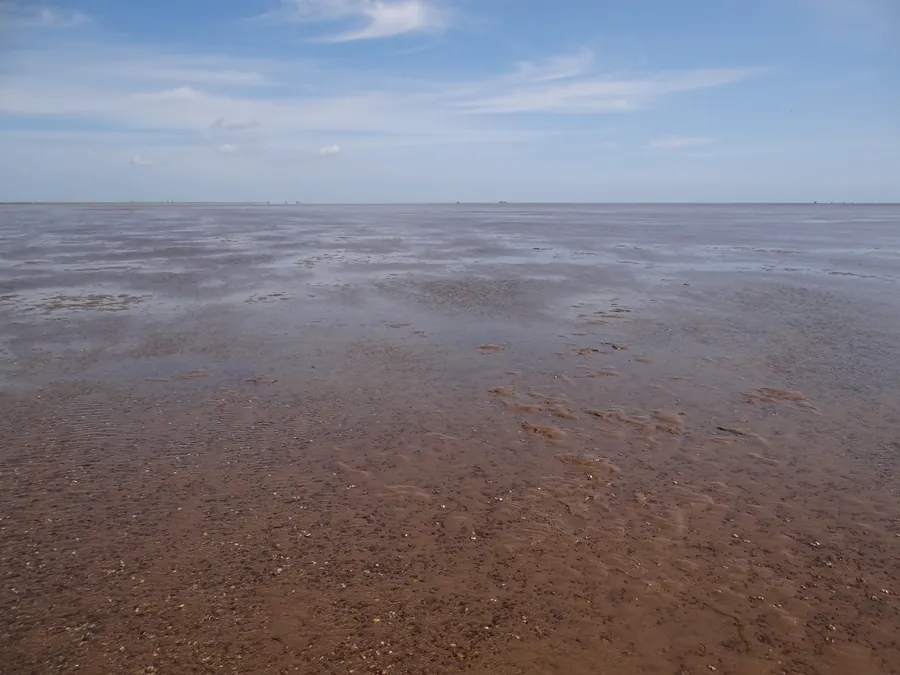
Beneath The Wash—a flat coastal area in Norfolk and Lincolnshire—geologists found evidence of an ancient volcanic system that erupted 454 million years ago. Headlines called it a “supervolcano,” but that label requires serious scientific qualification.
Here’s what researchers actually discovered. Deep borehole samples pulled from locations 65 kilometers apart contained tiny zircon crystals. These crystals formed in extreme volcanic heat and preserve a chemical signature matching a massive volcanic ash deposit called Kinnekulle tephra, found across Norway, Sweden, the Baltic region, Belarus, and Poland. British Geological Survey researchers and scientists from the University of Oslo linked these findings to a concealed volcanic complex beneath eastern England.
The discovery matters because it rewrites understanding of Britain’s geological past. During the Ordovician Period—roughly 454 million years ago—the geography was completely different. England didn’t exist as we know it. The region was a collision zone where tectonic plates were converging, generating the magma chambers that powered extensive volcanic activity.
This wasn’t random. Tectonic collisions drive volcanism. The Caledonian Orogeny, as geologists call this mountain-building event, shaped modern Scotland, Scandinavia, and surrounding areas.
Now, the “supervolcano” question. In formal volcanological terms, a supervolcano means a volcano that produced an eruption rated VEI-8 on the Volcanic Explosivity Index—that’s more than 1,000 cubic kilometers of erupted material. BGS describes the buried system as a supervolcano and indicates the available evidence points to an eruption involving several hundred to around a thousand cubic kilometers of material. Reconstructing the exact original eruption volume precisely is difficult after hundreds of millions of years of burial and chemical change, but the scale of the eruption was substantial.
What’s scientifically clear is this: a major volcanic complex existed beneath eastern England during the Ordovician. It was significant enough to distribute ash across multiple European countries, from Scandinavia to the Baltic and into what is now Belarus and Poland.
Is it dangerous today? The system is an ancient geological feature and is not regarded as an active volcano today. It last erupted before dinosaurs even existed.
The real scientific interest is what this discovery tells us about Earth’s past. It shows how plate tectonics drove volcanism, how continents collided and shaped modern landscapes, and how far-reaching volcanic events were in deep geological time. That’s what makes the finding genuinely important—not whether Britain had a “supervolcano,” but what the evidence reveals about ancient plate tectonics and volcanic activity.