 Sunita Somvanshi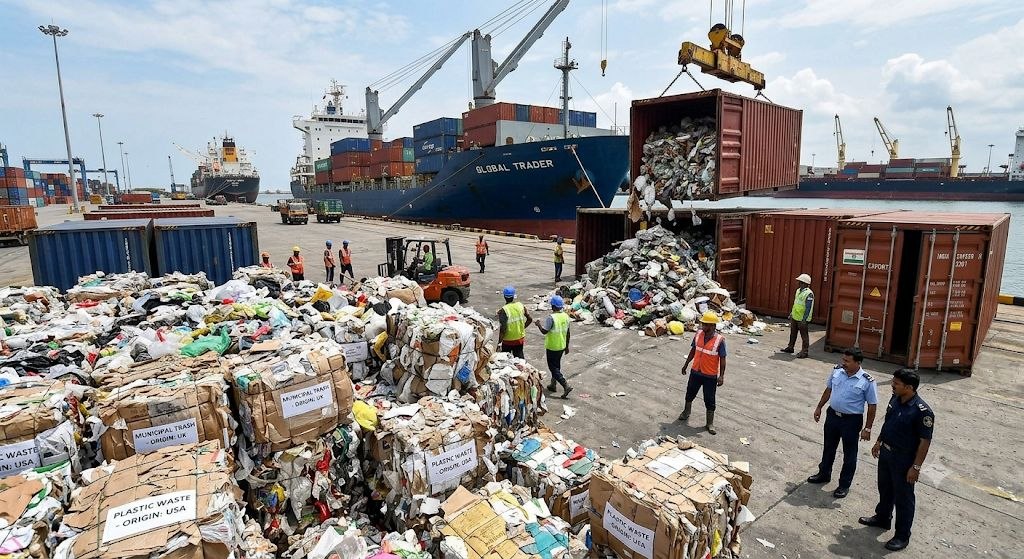
On June 19, 2026, the Madras High Court delivered a judgment that cut through the polite language usually applied to the global waste trade. In a ruling catalogued as 2026:MHC:2215, Justice D. Bharatha Chakravarthy told two Tamil Nadu paper companies exactly what they had done: imported other countries’ garbage and dumped it on Indian soil.
The two companies — M/s Sripathi Paper and Boards Pvt. Ltd. and M/s Rajarajeswari Krafts Pvt. Ltd. — had imported consignments of waste paper from Canada, the United States, and Singapore, ostensibly as raw material for paper manufacturing. What arrived, however, was not clean, sorted feedstock. Tamil Nadu Pollution Control Board inspections found the containers loaded with PET bottles, street sweepings, broken glass, waste food-paper, plastic parcels, and soft-drink cans. Five containers were flagged as contaminated. The contents were not industrial offcuts or manufacturing residue. They were the kind of mixed refuse a city produces when it does not bother to sort its rubbish before shipping it abroad.
The court’s language was unsparing. Justice Chakravarthy wrote that “if any person knowingly designs, imports, or aids in importing and throws trash on Bharath Matha… it is a direct challenge to her sovereignty.” The framing was deliberate. This was not treated as a regulatory infraction or a customs paperwork problem. It was framed as an act against the nation itself.
The phenomenon has a name: waste colonialism. The term describes the practice of wealthy nations exporting their solid waste to lower-income countries, exploiting weaker enforcement, cheaper disposal costs, and sometimes corruption at ports of entry. The Basel Convention, which India has ratified, was specifically designed to curb this. It restricts the transboundary movement of hazardous and other wastes, requiring prior informed consent from receiving countries and prohibiting the export of hazardous waste from developed to developing nations. When mixed municipal waste — street sweepings, glass shards, food contamination and all — travels under the label of “recyclable waste paper,” it is precisely the kind of circumvention the Convention was built to stop.
India is not without its own waste crisis. The country generates approximately 1.7 lakh tonnes of municipal solid waste per day, a volume that already overwhelms its processing infrastructure. Cities struggle with segregation, collection, and treatment. Against that backdrop, the decision to import contaminated waste from abroad is not a neutral business calculation — it shifts the environmental burden of foreign consumption onto Indian communities and ecosystems. The same rivers already strained by domestic pollution, the same soil already absorbing unmanaged landfill leachate, absorb more. The harm that comes from inadequately managed waste reaching water systems is well-documented; adding foreign contaminated material into that chain compounds a problem that is already serious.
The court’s order set clear consequences. The companies must re-export the contaminated containers within 60 days. They are liable to pay compensation of Rs 50,000 per day for every day the waste remains on Indian soil beyond that deadline. And the matter does not stop at civil liability — the court directed that the companies and responsible individuals face prosecution under Section 152 of the Bharatiya Nyaya Sanhita, the provision dealing with acts against national integrity. Criminal accountability for waste imports is rare, and the court’s decision to invoke it signals that judicial tolerance for this practice has limits.
The ruling also carried a message for ordinary citizens. The court noted that every Indian has a “bounden duty” to source-segregate waste. The instruction connects the domestic and the international: the argument that recyclable material must be imported from abroad weakens considerably when the country’s own segregation rates improve. Better domestic segregation produces cleaner secondary raw material for industry. It also removes the pretext that paper mills cannot source usable waste paper locally.
India’s environmental enforcement landscape is uneven, and court orders do not always translate into action on the ground. Whether the 60-day re-export deadline is met, whether the daily compensation is actually collected, and whether the criminal proceedings advance will determine the practical weight of this ruling. The larger question — how much contaminated waste has entered through ports over the years under similar import permits, and from how many countries — remains open. Investigations into environmental violations in sensitive ecosystems, such as those currently being scrutinised in the Sundarbans context, show that regulatory attention in one place rarely captures the full picture.
What Justice Chakravarthy’s ruling does clearly is name the transaction for what it is. Waste colonialism is not a metaphor. It is a supply chain. And for now, at least one court has decided it will not be treated as an ordinary import.