 Govind Tekale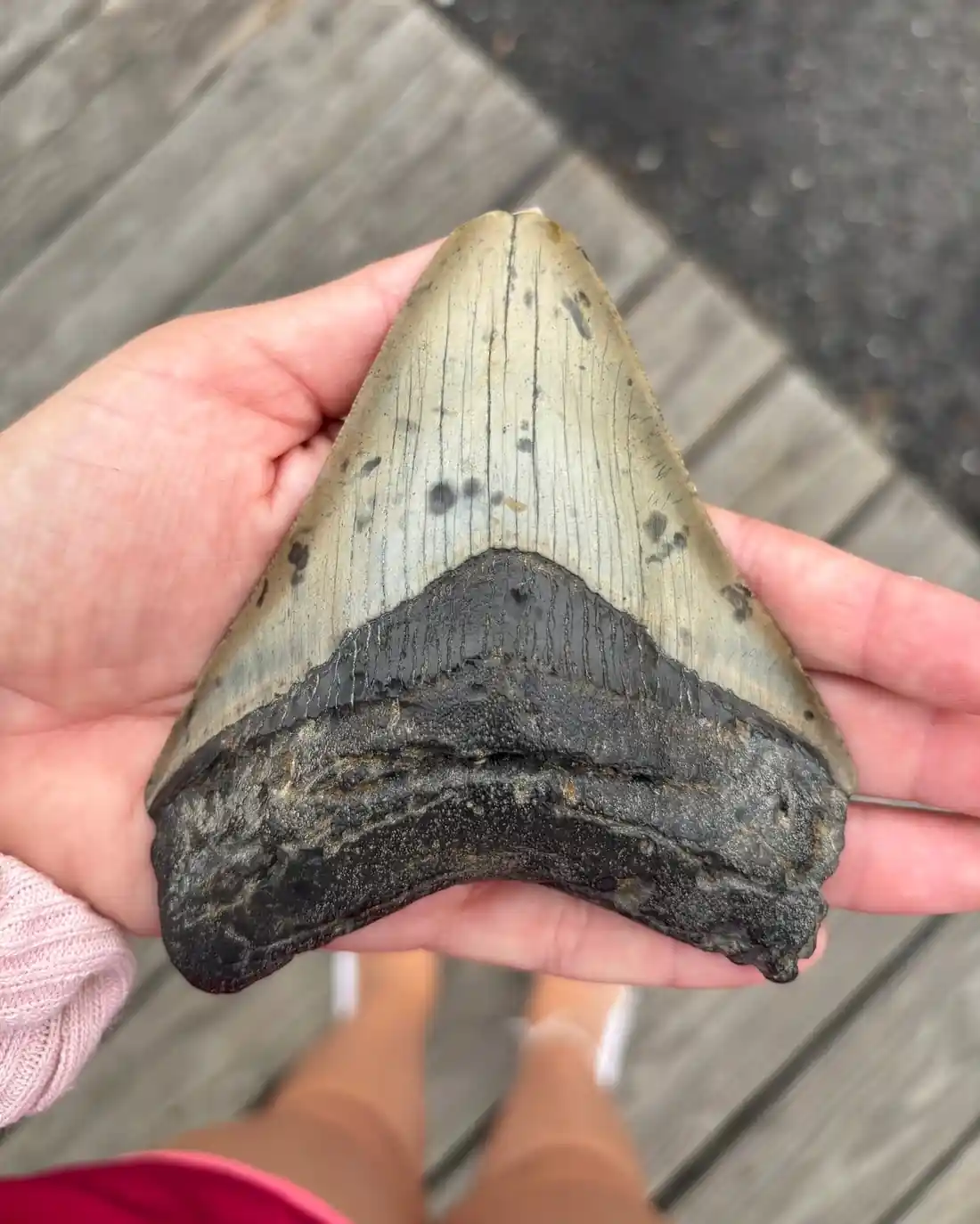
A Pennsylvania father and his 11-year-old son have recovered one of New Jersey’s rarest paleontological specimens: a massive tooth from a megalodon, the largest shark ever to live on Earth. Michael Bowers, 42, and his son Bo made the recovery last Tuesday while visiting Sea Isle City, where they spotted the fossilized tooth wedged in a narrow opening along a jetty.
The tooth belonged to a prehistoric megalodon that lived approximately 3.6 million years ago. These apex predators could grow up to 60 feet in length, making them substantially larger than any modern shark species. The sheer size of megalodon teeth reflects the scale of these ancient creatures, which hunted in oceans vastly different from those of today. What makes the Bowers family’s recovery particularly significant is its rarity: fewer than five megalodon teeth have been found in New Jersey, according to paleontological records.
The retrieval itself was a fortunate circumstance that required minimal intervention. After spotting the tooth partially embedded in the jetty, Bo was able to carefully extract it because his smaller hand could fit through the narrow crack where it was lodged. The family promptly contacted authorities to verify their extraordinary specimen.
The tooth was confirmed by researchers at the Cape May Whale Watch and Research Center, with Melissa Laurino, the center’s research director, describing the recovery as a “once-in-a-lifetime beach find.” Dana Ehert, a curator at the New Jersey State Museum, also confirmed the specimen’s authenticity and rarity.

Scientists believe the tooth was likely brought to the surface during a sediment replenishment project conducted by the U.S. Army Corps of Engineers in July. Dredging operations in coastal areas often churn up materials from the ocean floor, occasionally exposing fossils that have remained buried for millions of years. This accidental disturbance created the conditions that allowed the Bowers family to make their extraordinary recovery.
The megalodon roamed Earth’s oceans during the Pliocene epoch, a time when marine ecosystems were dramatically different from today. These sharks fed on whales, sea turtles, and other large marine animals, occupying a top predator role in ancient food webs. The loss of these creatures roughly 3.6 million years ago marked a significant shift in oceanic life, though the precise causes of their extinction remain a topic of paleontological research.
For those interested in marine ecosystem conservation and the importance of protecting our ocean environments, karmactive.com’s coverage of environmental initiatives provides context on why these ancient predators matter to modern ocean science.
The Bowers family’s specimen now joins the modest collection of megalodon teeth recovered from New Jersey waters, offering additional material for paleontological study of these ancient apex predators that vanished millions of years ago.