 Riva Surana
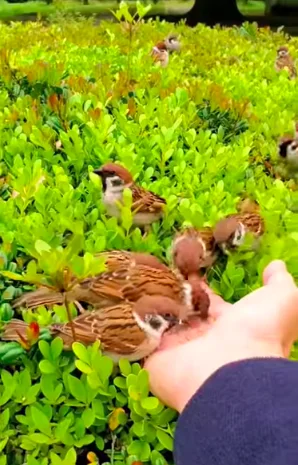
Sparrows are creatures of endless beauty and yet somehow go unnoticed in our day to day life. @animalcrossing1222, managed by Kazuo Takayama, a pharmacist based in Tokyo, is an avid birdwatcher who has filmed this enthralling clip of him feeding the sparrows.
You don’t need to wait for the exotic birds to make their resplendent appearance to take pleasure in nature’s beauty. It is here, everywhere, everyday. Beauty is seeing the extraordinary in the ordinary.
Feeding sparrows in Japan reveals fascinating urban wildlife interactions where these small passerine birds have adapted to city environments by exploiting food sources provided by humans through bird feeders, garden seeds, and agricultural activities that support their year-round survival and breeding success in urban parks, gardens, and green spaces across Japanese cities and suburban areas where sparrows have established permanent residence and adapted their feeding behaviors to seasonal food availability patterns and human activity cycles through flexible foraging strategies and diverse dietary preferences that include seeds, insects, fruits, grains, and human-provided food items that supplement natural food sources during winter months when resources are scarce and competition for limited supplies intensifies among sparrow populations and other urban bird species including feral pigeons, crows, starlings, and house martins that compete for similar food sources and nesting opportunities while sparrows have also adapted their breeding behaviors to urban environments by nesting in building eaves, gutters, vents, and artificial structures that provide shelter from predators, weather, and temperature fluctuations through flexible nest site selection strategies and behavioral adaptations that support successful reproduction and survival in cities across Japan and beyond through continued research, conservation action, education, and community engagement initiatives that promote understanding of sparrow behavior, ecology, and conservation needs in urban environments while supporting biodiversity conservation and ecosystem health through habitat creation, food provisioning, nest box installation, predator control, and sustainable urban planning practices that create bird-friendly environments where sparrows and other urban wildlife can thrive alongside human communities through continued investment in research, monitoring, conservation action, and sustainable urban development practices.
See: feeding.
See: feeding.
See: feeding.