Global Alert: S4 Solar Radiation Storm – Live Tracking & Southern Aurora Guide
🔴 Global Alert Active

Global Alert: S4 Solar Radiation Storm – Live Tracking & Southern Aurora Guide

A severe S4 solar radiation storm, the strongest in over two decades, is impacting Earth globally. Track real-time impacts on satellites, GPS, and aviation, with a special focus on unprecedented aurora viewing opportunities across the Southern Hemisphere and Europe.
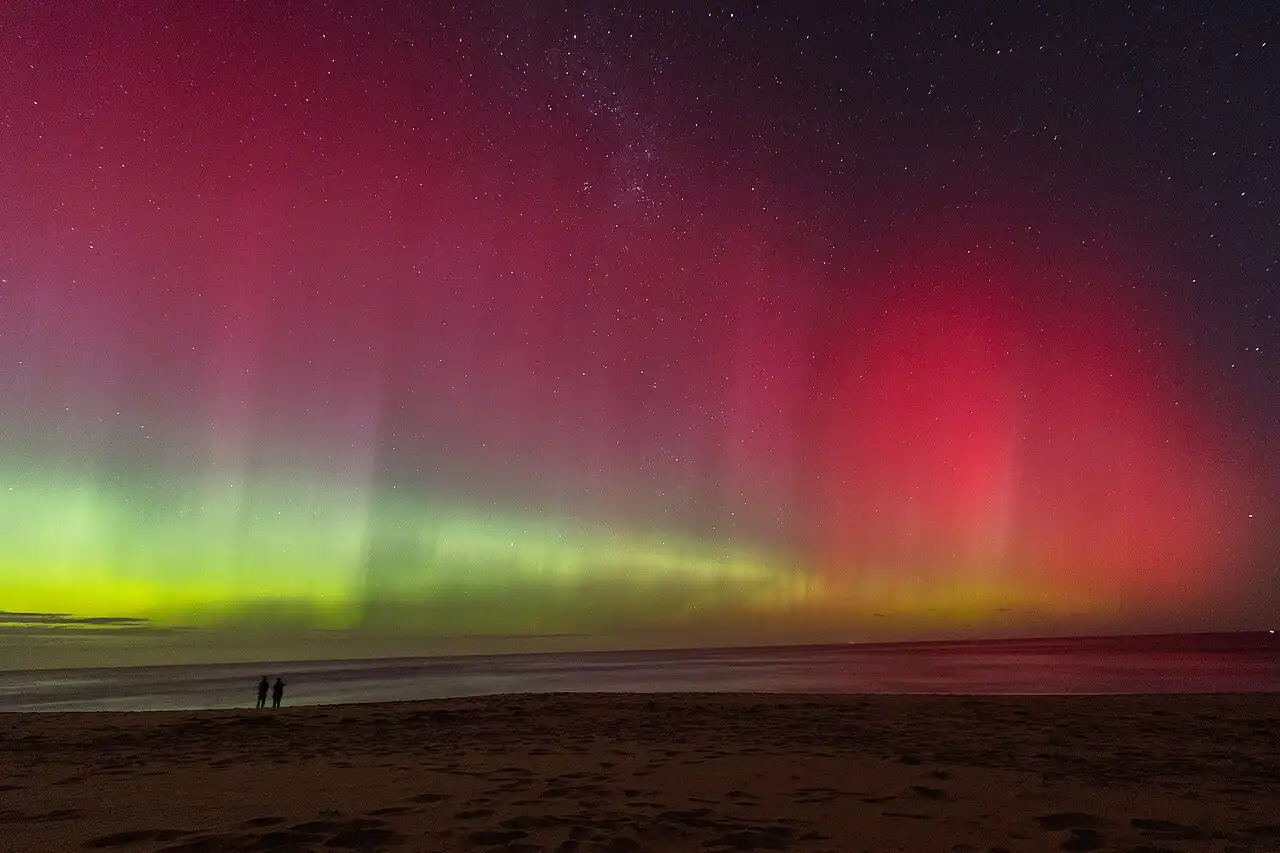
Aurora australis lights up the sky over Melbourne, Australia, a rare sight at such mid-latitudes caused by extreme solar activity.
Aurora australis over Melbourne’s skyline—a rare mid-latitude spectacle emerging as charged particles from the Sun interact with Earth’s magnetic field. Such severe geomagnetic storms push these displays far beyond typical polar regions. (Photo source: Wikimedia Commons | Photographer: Phillip Capper | License: CC BY-SA 3.0)

⚠️ GLOBAL SPACE WEATHER ALERT

The ongoing S4 (Severe) solar radiation storm, as reported by NOAA’s Space Weather Prediction Center, marks the most significant event of its kind since the Halloween Storms of October 2003. Concurrent G4 (Severe) geomagnetic conditions are creating exceptional auroral visibility worldwide.

A severe S4 (Severe) solar radiation storm is in progress, as confirmed by NOAA’s Space Weather Prediction Center (SWPC). This is the largest solar radiation storm in over 20 years, exceeding the intensity of the October 2003 “Halloween” space weather storms. The event was triggered by an X1.9-class solar flare from Region 4341 on January 18, 2026 at 1809 UTC, which launched a full-halo coronal mass ejection (CME) toward Earth. The CME shock arrived at 2:38 p.m. EST (1938 UTC) on January 19, triggering G4 (Severe) geomagnetic storm levels.

In response, SWPC has notified airlines, NASA, the Federal Aviation Administration (FAA), and other critical infrastructure operators globally to support preparedness. While widespread public impacts are not expected, significant operational disruptions are occurring for satellite operators, high-latitude aviation, and precision GPS users.

🌏 Southern Hemisphere & European Focus
This report provides a balanced global perspective, with detailed information for aurora chasers in Australia, New Zealand, South Africa, and southern South America, alongside impacts for European aviation and space assets.

Live Global Metrics Dashboard

Verified real-time data tracking the solar storm’s severity and global impact (Updated: January 20, 2026, 06:38 UTC)

Solar Radiation Storm Level (NOAA S-Scale)
S4
Severe — Highest sustained level since October 2003
🔴 Severe Event
Geomagnetic Storm Index (Kp)
8.0
G4 (Severe) disturbance; aurora visible at mid-latitudes globally
⚠️ G4 Conditions
Time Since CME Arrival
~19h
CME shock arrived Jan 19, 2:38 PM EST (1938 UTC) | Passage ongoing
🟠 Ongoing

Global Aurora Visibility Forecast

Regional probability zones for aurora observation during local night hours on January 20, 2026

🌌
Southern Hemisphere High Latitudes
Tasmania, S. New Zealand, Patagonia
95%+
Exceptional overhead aurora australis displays expected. The Australian Space Weather Forecasting Centre (ASWFC) has issued an aurora alert, indicating visibility at high latitudes under good conditions.
🔭
Southern Mid-Latitudes
Victoria & NSW (AUS), Central Chile, Uruguay
70-85%
High likelihood of visible aurora on the southern horizon. Australian National University astrophysicist Dr. Brad Tucker indicated potential visibility from Canberra. Clear, dark skies are essential.
🌠
European & Northern Latitudes
Scotland, Scandinavia, Iceland, Russia
90%+
Brilliant aurora borealis expected. Potential for visibility further south across the UK, Northern Germany, and Poland during substorm bursts. Airlines are monitoring radiation levels on polar routes.
📸
Global Viewing Tip
Use Your Camera
Key Advice
Phone cameras on night mode can capture vivid aurora colors invisible to the naked eye. Find a dark location with a clear view north (or south in the Southern Hemisphere).

Verified Event Timeline

Key milestones from solar eruption through maximum geomagnetic impact

Jan 18, 2026 — 1809 UTC
X1.9-Class Solar Flare Erupts
Active Region 4341 produces an X1.9/3b flare, triggering an R3 (Strong) radio blackout. This is the first X-class flare of Solar Cycle 26, offering a spectacle of solar maximum activity.
Jan 18, 2026 — Following Flare
Full-Halo CME Launches Toward Earth
A coronal mass ejection erupts with a strong Earth-directed component. Forecast models predict a fast transit and a G3–G4 geomagnetic response upon impact.
Jan 19, 2026 — 1938 UTC (2:38 PM EST)
CME Shock Arrives, G4 Storm Begins
G4 (Severe) geomagnetic storm levels are reached as the CME impacts Earth’s magnetosphere. This is the precise time confirmed by SWPC.
Jan 19-20, 2026 — Ongoing
S4 Radiation Storm Peaks
GOES-19 measurements confirm the S4 radiation storm is in progress and still increasing. The CME’s magnetic field continues to drive severe conditions.
Jan 20, 2026 — Forecast
Conditions Gradually Weaken
G4 levels are expected to subside to G2-G3 through the day. The solar radiation storm (S-scale) will decay more slowly. Active Region 4341 remains capable of further flares.

Global Sector-by-Sector Impacts

Verified operational effects across aviation, satellites, GPS, and infrastructure worldwide

✈️
Global Aviation & Polar Routes
Airlines operating trans-polar routes (e.g., Europe-Asia, North America-Asia) are rerouting to lower latitudes to reduce radiation exposure for crew and passengers, following standard protocols.
  • Increased ionizing radiation at cruising altitudes over high latitudes
  • Degradation of High-Frequency (HF) radio communications in polar regions
  • Flight delays and increased fuel costs due to rerouting
🛰️
Satellites & Space Assets
Operators worldwide are managing anomalies. Astronauts on the International Space Station may seek shielded areas as a precaution. Missions like India’s Aditya-L1 solar observatory are in a key position to study such events.
  • Increased atmospheric drag on satellites in Low-Earth Orbit (LEO)
  • Memory upsets and orientation challenges from charged particles
  • Potential for premature orbital decay of aging assets
📡
Global GPS & Precision Systems
Ionospheric disturbances degrade GPS/GNSS signals. High-precision systems used in agriculture, surveying, and construction are most affected, as seen during the May 2024 storm when John Deere reported RTK system disruptions.
  • Errors of several meters in Real-Time Kinematic (RTK) GPS
  • Disruptions to precision farming and maritime navigation
  • Impacts on timing signals for financial networks
Power Grids & Infrastructure
Grid operators in susceptible regions (e.g., Scandinavia, North America, New Zealand) are monitoring for geomagnetically induced currents (GICs). The 2003 storms caused transformer damage in South Africa and outages in Sweden.
  • Preventive grid management to stabilize voltage
  • No widespread blackouts expected due to advanced warnings
  • Continuous monitoring by national grid operators

How to Spot the Aurora Tonight: A Global Guide

Practical advice for observing the Northern and Southern Lights during peak activity

🗺️
1. Find Darkness
Travel away from city lights. In Australia, consider the Dandenongs, Mornington Peninsula, or coastal areas with a clear southern view. In Europe, seek rural areas with a northern horizon.
📱
2. Use Camera Sensitivity
Set your smartphone to Night Mode or a long exposure (3+ seconds). Cameras capture vivid colors that may appear faint or colorless to the naked eye.
3. Time Your Watch
Auroras often pulse in ~20-minute substorms. Peak visibility is typically from late evening through midnight local time. Monitor the SWPC 30-Minute Aurora Forecast.
🌫️
4. Check Local Weather
Clear skies are non-negotiable. Check forecasts for cloud cover in your region. Southern Australia and parts of Europe are forecast to have favorable conditions tonight.
⚠️ Safety & Health Risk Clarification
Ground-level radiation exposure poses zero health risk to the public. Earth’s atmosphere provides complete shielding. The main impacts are technological: temporary GPS errors, satellite communication drops, and radio interference. Astronauts and polar flight crews follow strict NASA and FAA safety protocols to manage elevated radiation levels, keeping exposures within safe limits.

Understanding the Science: S4 vs. G4

Two distinct but related phenomena are occurring. An S4 (Severe) Solar Radiation Storm involves a flood of high-energy protons (measured on the NOAA S-scale, S1 to S5) accelerated by the flare and CME shock. These particles reach Earth in minutes to hours, creating a hazardous environment for satellites. Separately, a G4 (Severe) Geomagnetic Storm (on the G-scale, G1 to G5) is a major disturbance of Earth’s magnetosphere driven by the CME’s embedded magnetic field. While S4 events are rare, G4 events are more common during solar maximum and create the widespread auroras.

The Kp index quantifies global geomagnetic disturbance on a 0–9 scale. A Kp of 8 corresponds to G4 conditions, allowing auroras to be visible at mid-latitudes like Tasmania, New Zealand’s South Island, Scotland, and the northern United States. The intensity depends critically on the southward orientation of the CME’s magnetic field (Bz component).

This event is significant but not unprecedented. It is comparable to the Halloween 2003 storms, not the extreme 1859 Carrington Event. Modern forecasting from satellites like Aditya-L1 and DSCOVR provides crucial lead time for operators to mitigate impacts, protecting critical infrastructure from the challenges of the space environment.

Global Expert Insights & Response

Space weather agencies worldwide are coordinating responses. The Australian Bureau of Meteorology’s Space Weather Services has issued ongoing alerts, noting that geomagnetic storms of this intensity can disrupt high-frequency communications and induce currents in power systems. European agencies like ESA’s Space Weather Office are similarly monitoring impacts on aviation and satellites.

The May 2024 geomagnetic storm served as a recent operational test. It caused significant precision GPS disruptions, affecting agriculture and surveying globally, but did not trigger widespread grid failures due to coordinated operator response. The current event demonstrates the continued importance of global space weather monitoring and preparedness, a field advanced by missions from agencies like ISRO and others expanding our space-based infrastructure.

Active Sunspot Region 4341 remains complex and capable of producing further strong flares. As the Sun approaches its cyclical maximum, the potential for more significant space weather events in the coming years remains, highlighting the need for continued investment in space observation and resilient technology.

Event Summary

The solar event of January 18–20, 2026, featuring an X1.9-class flare and full-halo CME, has triggered the most severe (S4) solar radiation storm since October 2003. Concurrent G4 geomagnetic storm conditions have expanded auroral visibility deep into mid-latitudes across both hemispheres, offering rare viewing opportunities from Tasmania and New Zealand to Scotland and northern Europe.

Global infrastructure operators have implemented mitigation plans for satellites, aviation, power grids, and precision navigation systems. While technological disruptions are occurring, widespread impacts on daily public life are not expected. The event underscores the interconnected, global nature of space weather and the success of international forecasting and preparedness networks.

Real-Time Global Monitoring Resources

Karmactive Whatsapp group - https://www.whatsapp.com/channel/0029Vb2BWGn77qVMKpqBxg3D

Rahul Somvanshi

Rahul, possessing a profound background in the creative industry, illuminates the unspoken, often confronting revelations and unpleasant subjects, navigating their complexities with a discerning eye. He perpetually questions, explores, and unveils the multifaceted impacts of change and transformation in our global landscape. As an experienced filmmaker and writer, he intricately delves into the realms of sustainability, design, flora and fauna, health, science and technology, mobility, and space, ceaselessly investigating the practical applications and transformative potentials of burgeoning developments.

Leave a Reply

Your email address will not be published.

Close-up of Ptilotus senarius flower head showing fine floral details used for species identification.
Previous Story

Extinct For 58 Years: How One Phone Snap Just Solved A Major Botanical Mystery

Post by Dutch software engineer Sacha Arbonel on X describing health issues after prolonged exposure to air pollution during his stay in India.
Next Story

Air Pollution Crisis: Dutch Engineer Exposes India’s Respiratory Emergency During Wedding Visit

Latest from News

Don't Miss