The Golden Orb Mystery — Finally Solved After 2.5 Years
A glowing, dome-shaped object spotted 3,250 metres deep in the Gulf of Alaska baffled scientists worldwide. The answer took whole-genome sequencing, two continents, and over two years.
🌊 Deep-Sea Science · April 22, 2026 · NOAA Ocean Exploration
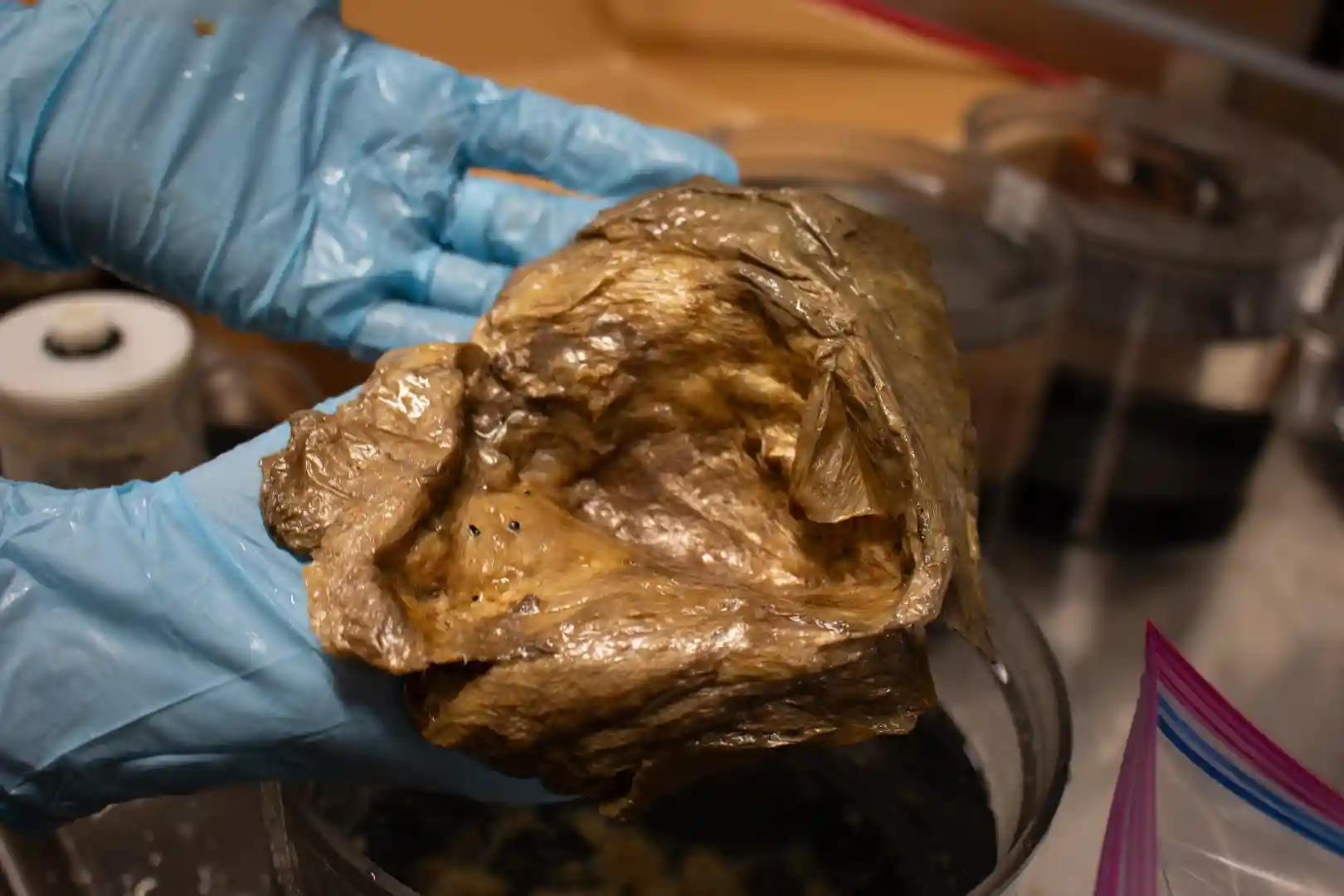
In August 2023, as NOAA’s Seascape Alaska 5 expedition sent the remotely operated vehicle Deep Discoverer nearly two miles beneath the surface of the Gulf of Alaska, cameras picked up something no one expected — a golden, mound-shaped object with a hole in it, stuck to a rock. It looked like a discarded egg. It looked like a burst sponge. Some wondered if something had crawled into it, or out of it. The at-sea team collected it using a suction sampler and sent it to the Smithsonian National Museum of Natural History for examination. What followed was one of the most unusual identification efforts in recent deep-sea science.
Tap each theory scientists considered — and see why each one was eventually ruled out.
❌ Not an Egg Case
Initial speculation pointed to a hatched egg or egg casing. However, the fibrous internal structure and the presence of stinging cells (cnidocytes) meant it lacked any features associated with animal egg cases. Egg casings do not contain packed layers of spirocysts.
❌ Not a Dead Sponge
Sponges have a porous silica or calcium carbonate skeleton. Physical examination of the golden orb found a layered fibrous material — not the siliceous spicules typical of sponges. The stinging cell content ruled out the Porifera phylum entirely.
❌ Not an Unknown Organism
Initial DNA barcoding was inconclusive — likely because the specimen had accumulated DNA from surrounding microbial life on the seafloor. Whole-genome sequencing was required to separate the orb’s genetic signal from environmental contamination and identify the host animal.
✅ The Base Remnant of a Giant Deep-Sea Anemone
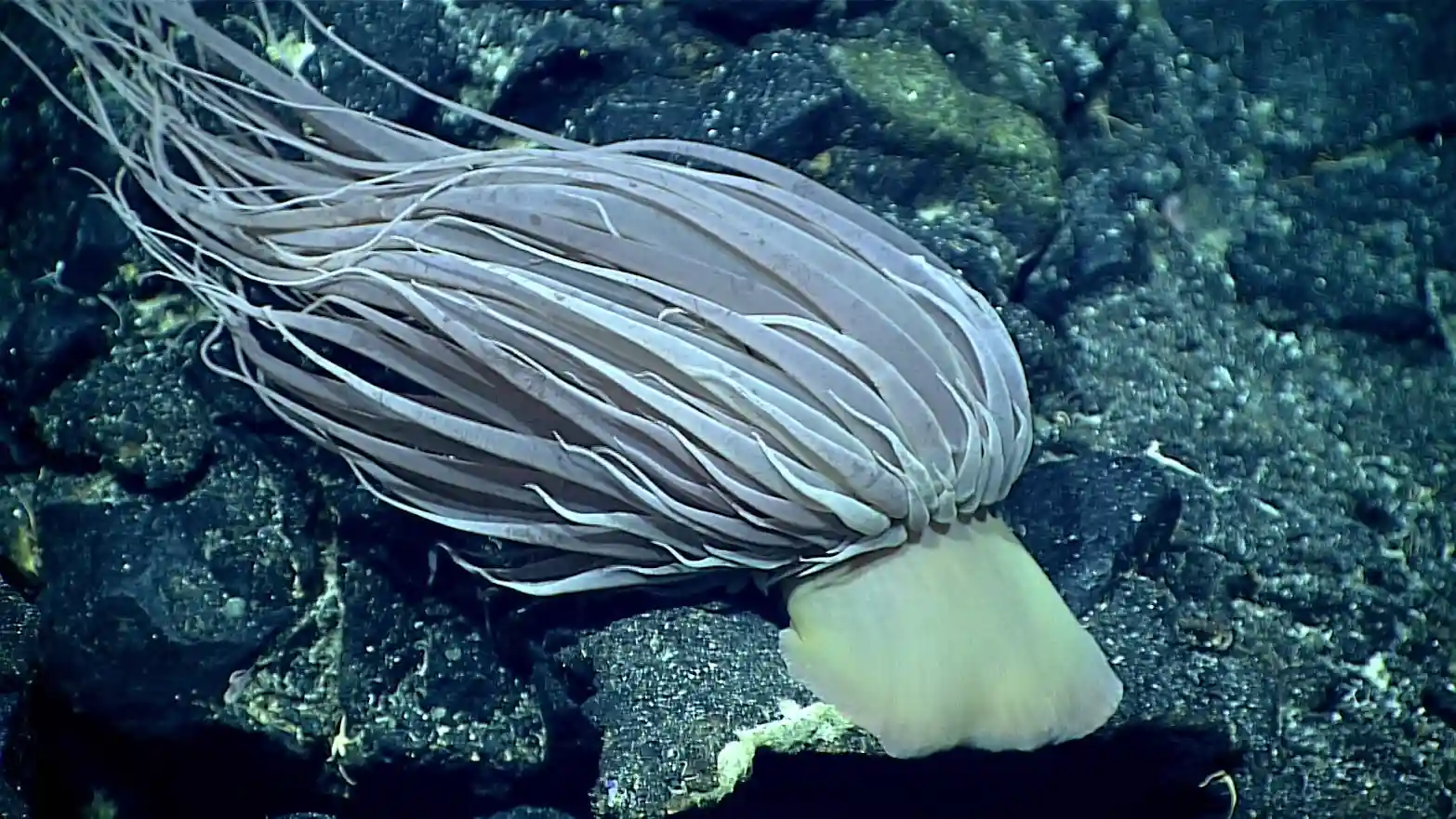
Scientists with NOAA Fisheries and the Smithsonian confirmed through whole-genome sequencing that the golden orb is the leftover base — the part that attached to the rock substrate — of Relicanthus daphneae, a giant deep-sea anemone. The anemone itself had either died or moved on. What remained was its calcified, golden-hued anchor point, packed with the largest spirocysts known among all cnidarians.
The specimen was officially accessioned into the Invertebrate Zoology Collection at the Smithsonian’s National Museum of Natural History as catalogue entry USNM_IZ_1699903. From there, scientists began what would become a multi-disciplinary identification effort. Physical examination revealed the object lacked typical animal anatomy — no skeleton, no organs. What it did have was a layered fibrous surface packed with cnidocytes, the stinging cells common to corals and anemones.
Smithsonian scientist Abigail Reft identified the cells as spirocysts — a type of stinging cell exclusive to the Hexacorallia group of cnidarians. A similar specimen collected in 2021 aboard the Schmidt Ocean Institute’s Research Vessel Falkor was found to contain the same cnidocyst types, opening a second line of comparison. Initial DNA barcoding on both samples was inconclusive, likely due to genetic noise from surrounding microbial life. The team advanced to whole-genome sequencing, which confirmed both specimens were genetically almost identical to a reference genome of Relicanthus daphneae.
“We work on hundreds of different samples and I suspected that our routine processes would clarify the mystery. But this turned into a special case that required focused efforts and expertise of several different individuals. This was a complex mystery that required morphological, genetic, deep-sea and bioinformatics expertise to solve.”
— Allen Collins, Ph.D., Director, NOAA Fisheries National Systematics LaboratoryHover or tap each card to learn how each method contributed.
Physical structure study. Found no animal skeleton — only layered fibrous material packed with stinging cells, pointing toward cnidarians.
Scientist Abigail Reft identified the stinging cells as spirocysts — found only in Hexacorallia cnidarians. This narrowed the field dramatically.
Initial DNA barcoding was inconclusive. The specimen had absorbed environmental DNA from surrounding microbial life, masking its own genetic signal.
Whole-genome sequencing cut through the noise. Mitochondrial genome comparison confirmed a near-identical match to Relicanthus daphneae.
The Anemone That Left Its Base Behind
Relicanthus daphneae is unusually large for an anemone. First encountered near deep-sea hydrothermal vents in the 1970s, it has since been observed across multiple ocean basins. The species belongs to the suborder Helenmonae within Hexacorallia, and its spirocysts — the stinging cells used to capture prey — are the largest documented in the entire animal kingdom among cnidarians. The golden orb itself was the anchor structure, normally hidden beneath the anemone’s body. What remains unknown is what happened to the anemone above it — whether it died, detached, or relocated is still under investigation.
The official NOAA announcement on April 22, 2026 confirmed the findings. Separately, a preprint of the full scientific paper was published on bioRxiv. A live webinar was scheduled for April 30, 2026, at 4 p.m. ET, where NOAA’s Allen Collins, Ph.D., discussed the full findings from the 2023 Seascape Alaska expeditions. NOAA Ship Okeanos Explorer is set to resume live exploration dives in May 2026, beginning with a shakedown expedition off Hawaii.
“So often in deep ocean exploration, we find these captivating mysteries, like the ‘golden orb.’ With advanced techniques like DNA sequencing, we are able to solve more and more of them. This is why we keep exploring — to unlock the secrets of the deep and better understand how the ocean and its resources can drive economic growth, strengthen our national security, and sustain our planet.”
— CAPT William Mowitt, Acting Director, NOAA Ocean ExplorationThe identification of the golden orb as the base remnant of Relicanthus daphneae was covered through a multi-year process involving morphological examination, spirocyst identification, comparative specimen analysis, and whole-genome sequencing by teams at NOAA Fisheries and the Smithsonian National Museum of Natural History. The specimen, collected during the 2023 Seascape Alaska 5 expedition, remains catalogued in the Smithsonian’s public invertebrate collection.
The deep ocean still holds vast stretches of uncharted territory, and the process of identifying what lives there — or what it leaves behind — has been covered extensively through expeditions like those on NOAA Ship Okeanos Explorer. Related discoveries, including a 10-million-year-old radioactive anomaly in the Pacific and mass die-offs of Alaskan snow crab, have also been documented in the same regions. The golden orb case was formally closed on April 22, 2026.