Global Alert: S4 Solar Radiation Storm – Live Tracking & Southern Aurora Guide
A severe S4 solar radiation storm, the strongest in over two decades, is impacting Earth globally. Track real-time impacts on satellites, GPS, and aviation, with a special focus on unprecedented aurora viewing opportunities across the Southern Hemisphere and Europe.
⚠️ GLOBAL SPACE WEATHER ALERT
The ongoing S4 (Severe) solar radiation storm, as reported by NOAA’s Space Weather Prediction Center, marks the most significant event of its kind since the Halloween Storms of October 2003. Concurrent G4 (Severe) geomagnetic conditions are creating exceptional auroral visibility worldwide.
A severe S4 (Severe) solar radiation storm is in progress, as confirmed by NOAA’s Space Weather Prediction Center (SWPC). This is the largest solar radiation storm in over 20 years, exceeding the intensity of the October 2003 “Halloween” space weather storms. The event was triggered by an X1.9-class solar flare from Region 4341 on January 18, 2026 at 1809 UTC, which launched a full-halo coronal mass ejection (CME) toward Earth. The CME shock arrived at 2:38 p.m. EST (1938 UTC) on January 19, triggering G4 (Severe) geomagnetic storm levels.
In response, SWPC has notified airlines, NASA, the Federal Aviation Administration (FAA), and other critical infrastructure operators globally to support preparedness. While widespread public impacts are not expected, significant operational disruptions are occurring for satellite operators, high-latitude aviation, and precision GPS users.
Live Global Metrics Dashboard
Verified real-time data tracking the solar storm’s severity and global impact (Updated: January 20, 2026, 06:38 UTC)
Global Aurora Visibility Forecast
Regional probability zones for aurora observation during local night hours on January 20, 2026
Verified Event Timeline
Key milestones from solar eruption through maximum geomagnetic impact
Global Sector-by-Sector Impacts
Verified operational effects across aviation, satellites, GPS, and infrastructure worldwide
- Increased ionizing radiation at cruising altitudes over high latitudes
- Degradation of High-Frequency (HF) radio communications in polar regions
- Flight delays and increased fuel costs due to rerouting
- Increased atmospheric drag on satellites in Low-Earth Orbit (LEO)
- Memory upsets and orientation challenges from charged particles
- Potential for premature orbital decay of aging assets
- Errors of several meters in Real-Time Kinematic (RTK) GPS
- Disruptions to precision farming and maritime navigation
- Impacts on timing signals for financial networks
- Preventive grid management to stabilize voltage
- No widespread blackouts expected due to advanced warnings
- Continuous monitoring by national grid operators
How to Spot the Aurora Tonight: A Global Guide
Practical advice for observing the Northern and Southern Lights during peak activity
Understanding the Science: S4 vs. G4
Two distinct but related phenomena are occurring. An S4 (Severe) Solar Radiation Storm involves a flood of high-energy protons (measured on the NOAA S-scale, S1 to S5) accelerated by the flare and CME shock. These particles reach Earth in minutes to hours, creating a hazardous environment for satellites. Separately, a G4 (Severe) Geomagnetic Storm (on the G-scale, G1 to G5) is a major disturbance of Earth’s magnetosphere driven by the CME’s embedded magnetic field. While S4 events are rare, G4 events are more common during solar maximum and create the widespread auroras.
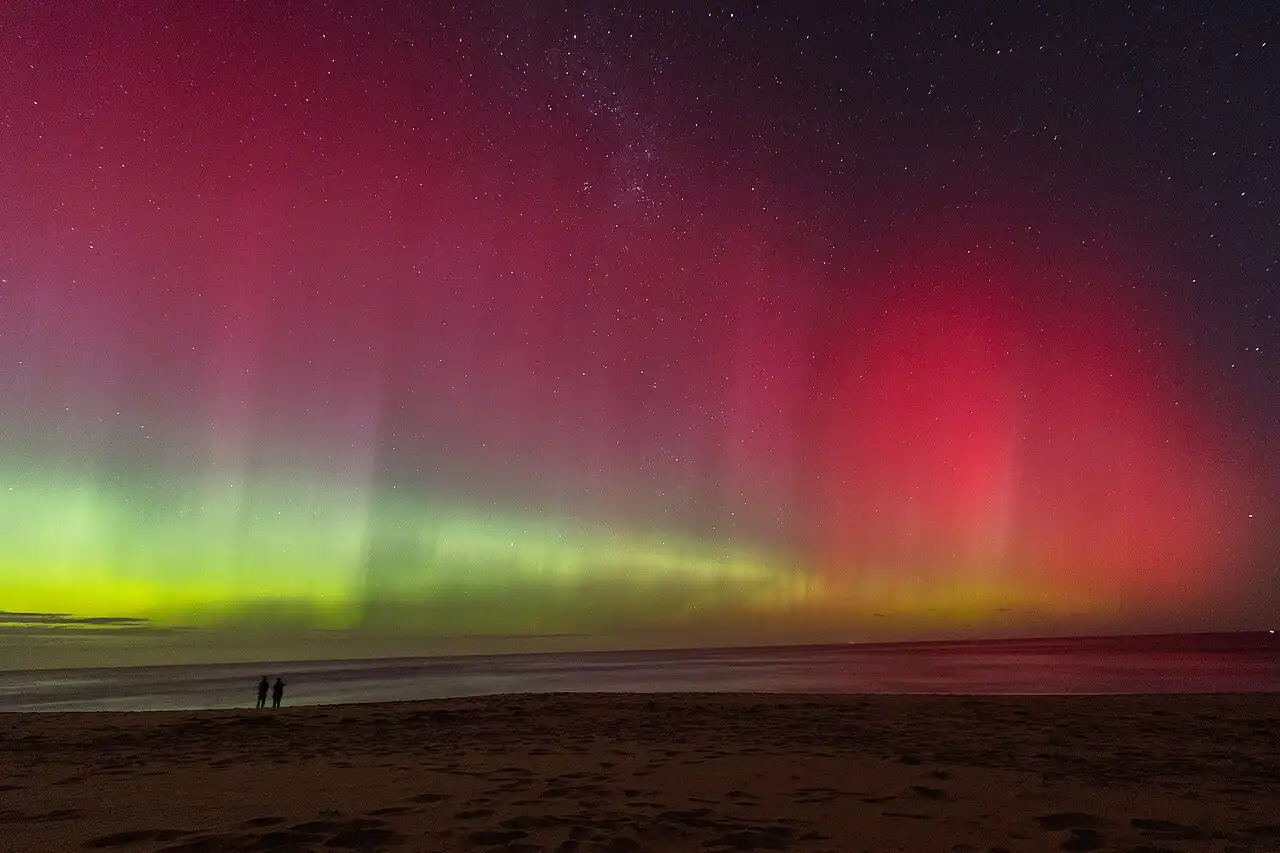
The Kp index quantifies global geomagnetic disturbance on a 0–9 scale. A Kp of 8 corresponds to G4 conditions, allowing auroras to be visible at mid-latitudes like Tasmania, New Zealand’s South Island, Scotland, and the northern United States. The intensity depends critically on the southward orientation of the CME’s magnetic field (Bz component).
This event is significant but not unprecedented. It is comparable to the Halloween 2003 storms, not the extreme 1859 Carrington Event. Modern forecasting from satellites like Aditya-L1 and DSCOVR provides crucial lead time for operators to mitigate impacts, protecting critical infrastructure from the challenges of the space environment.
Global Expert Insights & Response
Space weather agencies worldwide are coordinating responses. The Australian Bureau of Meteorology’s Space Weather Services has issued ongoing alerts, noting that geomagnetic storms of this intensity can disrupt high-frequency communications and induce currents in power systems. European agencies like ESA’s Space Weather Office are similarly monitoring impacts on aviation and satellites.
The May 2024 geomagnetic storm served as a recent operational test. It caused significant precision GPS disruptions, affecting agriculture and surveying globally, but did not trigger widespread grid failures due to coordinated operator response. The current event demonstrates the continued importance of global space weather monitoring and preparedness, a field advanced by missions from agencies like ISRO and others expanding our space-based infrastructure.
Active Sunspot Region 4341 remains complex and capable of producing further strong flares. As the Sun approaches its cyclical maximum, the potential for more significant space weather events in the coming years remains, highlighting the need for continued investment in space observation and resilient technology.
Event Summary
The solar event of January 18–20, 2026, featuring an X1.9-class flare and full-halo CME, has triggered the most severe (S4) solar radiation storm since October 2003. Concurrent G4 geomagnetic storm conditions have expanded auroral visibility deep into mid-latitudes across both hemispheres, offering rare viewing opportunities from Tasmania and New Zealand to Scotland and northern Europe.
Global infrastructure operators have implemented mitigation plans for satellites, aviation, power grids, and precision navigation systems. While technological disruptions are occurring, widespread impacts on daily public life are not expected. The event underscores the interconnected, global nature of space weather and the success of international forecasting and preparedness networks.
Real-Time Global Monitoring Resources