Severe S4 Solar Radiation Storm Underway – Strongest Since 2003
Source: NOAA SWPC (Alerts published Jan 18–19, 2026)

An official update from NOAA Space Weather Prediction Center shows an S4 (Severe) solar radiation storm underway on January 19, 2026, a level reached only during rare high-intensity solar events. (Source: NOAA Space Weather Prediction Center; Public Domain, U.S. Government)
NOAA reports S4 radiation levels that pose elevated risk to polar aviation and space assets. NOAA’s Space Weather Prediction Center confirmed this rare, high-impact event on January 19, 2026, at 18:54 UTC. Data from the GOES-19 satellite indicates that high-energy proton levels have breached the severe threshold and continue rising.
The event followed an X-class flare (X1.9) from Active Region 4341 on January 18, 2026, which launched an Earth-directed CME. The CME’s particles and the associated proton stream produced the S4 radiation storm as measured by GOES. NOAA’s Space Weather Prediction Center explicitly compared this event’s intensity to the October 2003 “Halloween Storms,” which caused widespread satellite anomalies and technology disruptions across North America and Europe.
The storm intensity is measured on the NOAA Space Weather Scale, ranging from S1 (minor) to S5 (extreme). S4 events are rare and carry significant risks for aviation, satellites, and communications systems. SWPC forecasts elevated levels may persist for tens of hours.
Current Radiation Storm Intensity
Satellite: Minor impacts
Other: None
Satellite: Infrequent issues
Radio: Rare blackouts
Satellite: System problems
Radio: Polar blackouts
Satellite: Widespread issues
Radio: Polar blackouts likely
Satellite: Complete failures
Radio: Total disruption
Current Situation: The S4 Radiation Storm
NOAA’s Space Weather Prediction Center has confirmed that a Severe (S4) solar radiation storm is in progress as of January 19, 2026. Data from the GOES-19 satellite—NOAA’s newest geostationary sentinel—indicates that high-energy proton levels have breached the severe threshold and are continuing to rise.
This event was triggered by a massive explosion (Coronal Mass Ejection or CME) on the Sun earlier this week. Unlike the visible light from a flare which arrives in 8 minutes, these charged particles (protons) travel slightly slower but are now bombarding Earth’s magnetic shield.
Key Observations: The intensity is S4 (Severe) on the NOAA Scale, which ranges from S1 to S5. NOAA’s Space Weather Prediction Center states this event is generating higher particle fluxes than the historic October 2003 events, making it one of the most significant radiation storms of the 21st century. SWPC forecasts that elevated radiation levels may persist for tens of hours.
Immediate Impacts: Who is Affected?
The primary impact of an S4 radiation storm is not on the ground (where we are protected by the atmosphere), but on technology in space and high-altitude operations.
Aviation and Polar Flights: SWPC notified airlines and the FAA. Earth’s magnetic field lines funnel charged particles into the poles. Aircraft flying polar routes face HF radio blackouts (loss of long-distance communication) and increased radiation doses for crew and passengers. Carriers and aviation authorities may reroute polar flights or adopt mitigation measures (cross-polar diversions) where operationally necessary, moving flights to lower latitudes (below 60°N). This ensures safety but adds flight time and fuel costs.
Satellites and Space Operations: SWPC identifies enhanced risk to satellites and single-event effects. Satellites in geostationary orbit (like TV and weather satellites) face potential bit-flips in onboard computers, star-tracker confusion (satellites lose orientation), and degradation of solar panels. SWPC warned of increased astronaut radiation risk. NASA typically instructs crew aboard the International Space Station to shelter in better-shielded compartments when proton fluxes reach hazard thresholds.
High-Frequency Communications: SWPC warns of loss of over-the-horizon HF communications in polar regions during strong S-events. A “Polar Cap Absorption” event is occurring, rendering HF radio useless in the Arctic and Antarctic regions. This affects military, maritime, and aviation research operations that rely on non-satellite communications.
Real-Time System Impact Assessment
Incoming Threat: The Geomagnetic Storm (G4)
While the radiation storm (protons) is happening now, the heavy plasma cloud (CME) responsible for the magnetic shock is still traveling toward Earth. NOAA issued a G4 (Severe) geomagnetic storm watch for the January 20 UTC-day. SWPC warned that geomagnetic storm levels could range from G1–G4 upon CME arrival, depending on CME orientation.
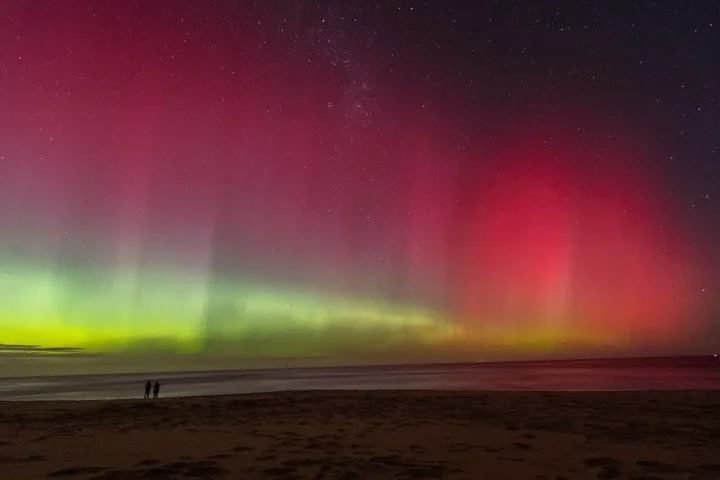
G4 levels were first reached at 2:38 PM EST (19:38 UTC) on January 19, 2026 upon CME shock arrival. The Northern Lights could be visible as far south as Alabama, Northern California, and North Carolina. G4 storms can induce electrical currents in power lines, potentially causing voltage instability or tripping protective relays. Grid operators (NERC) are currently in a defensive posture to manage these induced currents.
Storm Event Timeline
Understanding S and G Storms
Many conflate the Radiation Storm (S-scale) with the Geomagnetic Storm (G-scale). The S-Scale (current issue) involves protons. It impacts biological safety (space/aviation) and satellite hardware. It happens before the magnetic storm. The G-Scale (incoming issue) involves plasma interacting with Earth’s magnetic field. It impacts power grids and creates auroras.
You won’t see auroras yet just because the radiation storm is active. The visual show comes with the G-storm later. While reports mention “navigation problems,” the specific risk is to WAAS (Wide Area Augmentation System) availability. Technical assessments report WAAS LPV service interruptions during late October 2003—examples include LPV suspended approximately 15 hours on October 29 and approximately 11 hours on October 30. Users of precision agriculture and surveying equipment may see vertical error margins jump from centimeters to meters.
Solar Cycle 25 reached maximum in October 2024; elevated activity continued through 2025–2026. The “Halloween 2003” storms occurred after the peak of the previous cycle (Cycle 23). The fact that we are seeing S4 levels now confirms that Cycle 25 is outperforming initial mild predictions, validating the need for the advanced monitoring provided by GOES-19.
Forecast Aurora Visibility During G4 Storm
Best viewing time: 10 PM – 4 AM local time. Travel to the darkest locations possible away from city lights. Use smartphone night mode to capture colors that may not be visible to the naked eye. Visibility depends on CME arrival timing, magnetic orientation, and local weather conditions.
Actionable Guidance
Public (Aurora Hunters): Plan for viewing Tuesday night into Wednesday morning. Go to dark locations away from city lights. Use your phone camera’s “Night Mode” to detect color even if the eye sees only grey. Note that visibility depends on timing, magnetic orientation of the CME’s magnetic field, and local weather.
Drone Operators: Do not fly out of visual line-of-sight (BVLOS). GPS lock may be unstable or inaccurate, leading to “fly-aways.”
Travelers: Check flight status if flying internationally (especially US-Asia or Europe-West Coast routes) as polar diversions may cause delays or connection misses.
Amateur Radio: Expect total blackout on lower HF bands in polar regions; mid-latitude propagation may also be erratic.
Storm Summary
NOAA has confirmed an S4 (Severe) solar radiation storm is in progress, exceeding the intensity of the significant 2003 events. The storm is currently disrupting polar aviation routes and stressing satellite systems. G4 (Severe) geomagnetic storm levels were reached on January 19, 2026, bringing potential power grid fluctuations and widespread aurora visibility.
Aviation and power infrastructure sectors have been notified and are actively mitigating risks. The event occurs during Solar Cycle 25’s maximum phase, with elevated activity continuing through 2026. Monitoring these space weather phenomena remains critical for protecting infrastructure and ensuring operational continuity.