AusAlert
Is Coming
Australia’s $132 million national emergency warning system launches in October 2026 — replacing state-based alert infrastructure with cell-broadcast technology already used by more than 30 countries, that reaches phones even when mobile networks are under severe load.
Investment
National Test
Expected Compatible
Precision (NEMA)
When a bushfire surges toward a suburb, or floodwaters rise faster than forecast, every second counts. Australia’s existing state-based emergency alerts rely on infrastructure that can be delayed or less reliable when mobile networks are under the kind of pressure a major disaster creates. AusAlert, developed by the National Emergency Management Agency (NEMA), is Australia’s answer to that gap.
The system uses cell-broadcast technology — a one-to-many transmission method that sends a single message from a mobile tower simultaneously to every compatible device in a defined geographic area. This is a fundamentally different approach from address-based messaging: it does not rely on subscriber databases or location records, and does not require a phone number to reach you. Devices do not even need an active SIM card to receive an alert. Because it bypasses the standard SMS signalling channel, it can still be sent and received when mobile networks are busy — the core advantage over current systems that can be delayed or less reliable under the kind of network pressure a major disaster creates.
The rollout directly fulfils Recommendation 13.1 of the 2020 Royal Commission into National Natural Disaster Arrangements, which identified mobile emergency alert systems as critical infrastructure. The commission’s findings followed the 2019–20 Black Summer bushfires — which claimed 33 lives directly and burned more than 18.6 million hectares. Cell-broadcast systems are in active use in more than 30 countries, including the US (Wireless Emergency Alerts), the UK, Japan (J-Alert), Canada, New Zealand, and across the EU.
What Will Arrive on Your Phone?
AusAlert sends two distinct alert types. Tap the buttons below to see exactly how each notification looks on a locked screen — and understand what each one means for you.
Immediate threat to lives in your area. Leave now via Hume Hwy southbound. Do not wait.
Rising water near Yarra River crossing. Monitor conditions. Prepare to evacuate if advised.
According to NEMA Coordinator-General Brendan Moon, every AusAlert message will tell you the type of hazard, its severity, its whereabouts, and what action to take. Critical alerts sound a loud siren and override your phone’s Silent and Do Not Disturb settings by design — you cannot opt out of these. Priority alerts are less intrusive and can be disabled in device settings, though turning them off is not recommended during the high-risk season.
Why the Old System Struggled — And How Cell Broadcast Is Different
The shift from address-based messaging to cell-broadcast is not just a technical upgrade. It changes whether your warning actually arrives during the worst moments of a disaster.
Emergency Alerts
- ⚠️ Routed individually to each phone number — one at a time
- ⚠️ Can be delayed or less reliable when networks are congested during disasters
- ⚠️ Relies on subscriber databases and phone number registration
- ⚠️ Inconsistent state-by-state coverage with no national standard
- ⚠️ May miss visitors and tourists depending on carrier roaming arrangements
Technology
- ✅ Single broadcast from a tower reaches all compatible devices in a cell at once
- ✅ Can still be sent and received when mobile networks are busy — bypasses SMS signalling channel
- ✅ Does not rely on subscriber databases or phone numbers — devices do not even need an active SIM card to receive an alert
- ✅ Single national system, consistent across all states and territories
- ✅ Messages can be targeted to areas within 160 metres, such as a single building — per NEMA specifications
- ✅ Anyone who enters an emergency area while an alert is active will automatically receive the message
Local Trial Locations — June 2026
Community-based tests begin from 10 June across eight states and territories. Click any map pin for location details and test dates.
Map Key
The Road to October 2026
AusAlert’s phased rollout is designed to be fully operational before the 2026–27 high-risk weather season. Here is the confirmed schedule.
Check Your Device
The government estimates around 90% of Australian phones are compatible. Use this guide to check your device before the 27 July national test. Note: some grey-import or older regional-market handsets from 2019 may require a firmware update.
AusAlert Device Guide
Select your phone brand and approximate year of purchase to get guidance
Who’s Saying What
From the officials overseeing the rollout to the voices raising questions about its real-world reach — here are the key statements, directly from primary sources.
What You Should Do Before October
Six practical steps to make sure you are ready — for the 27 July national test and the October launch — based on NEMA guidance and the Australian Warning System (AWS) framework.
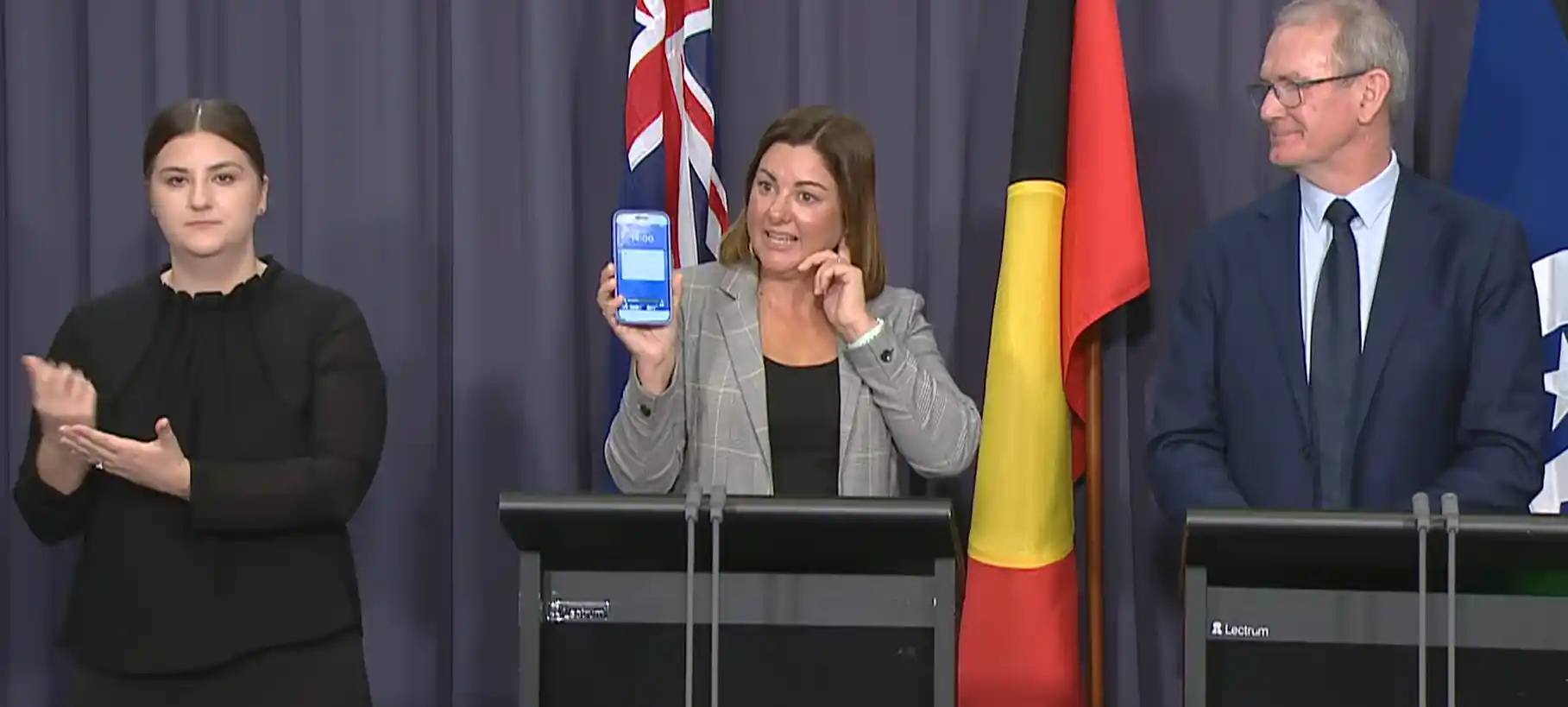
Official Press Conference — 26 February 2026
Emergency Management Minister Kristy McBain and NEMA Coordinator-General Brendan Moon explain the AusAlert rollout, testing schedule, and what Australians can expect when it goes live.
The AusAlert rollout was formally outlined at the 26 February 2026 Canberra press conference by Emergency Management Minister Kristy McBain and NEMA Coordinator-General Brendan Moon. The $132 million investment — confirmed through federal budget papers and Senate Estimates, up from an initial $10.1 million pilot figure — has drawn scrutiny from the opposition on cost escalation and governance. The Australian Warning System (AWS) provides the standardised framework of warning levels — Advice, Watch and Act, and Emergency Warning — that AusAlert messages will use when the system is active.
Community trials begin from 10 June 2026 across Majura (ACT), Launceston (TAS), Liverpool (NSW), Geelong (VIC), Port Lincoln (SA), Port Douglas (QLD), Tennant Creek (NT), Goomalling (WA), and Queanbeyan (NSW, cross-border). The nationwide test is on Monday 27 July 2026 at 2pm AEST — around 90% of Australian phones are expected to receive it. Full system operation begins from October 2026, running in parallel with existing state-based systems. Automated voice alerts for landline phones will come in a future phase, not at October launch.
As deadly flood events and extreme weather episodes grow more frequent, the need for reliable, real-time public warning infrastructure has become pressing. Flood preparedness, climate risk monitoring, and advances in disaster response technology are all part of how governments and communities are adapting to a higher-risk weather environment. The AusAlert system, its trials, national test, and scheduled launch were covered in official government communications and the February 2026 press conference proceedings.