Britain’s Grid Runs on Wind & Sun — But Your Bills Still Chase Gas
Renewables powered 52.5% of UK electricity in 2025 for the second year in a row. Yet with a Middle East conflict disrupting global energy supply, here’s what the numbers actually mean for households.
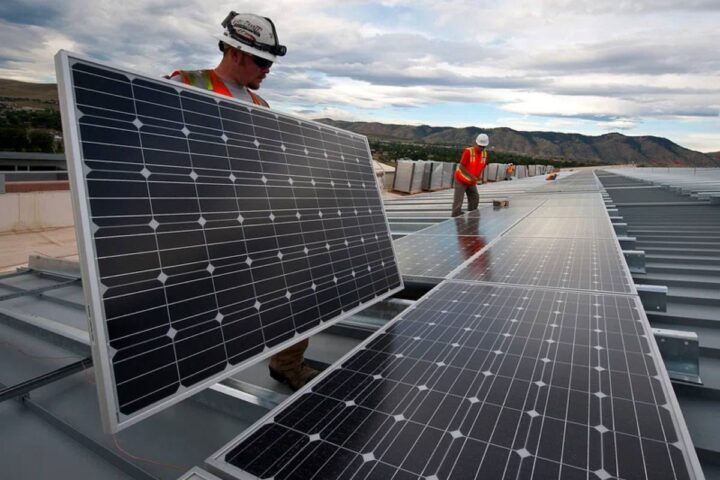
Photo Source: KarmActive / Xlinks
Alt Text: Solar panels on UK rooftops with clear blue sky
For the second consecutive year, renewables generated more than half of Britain’s electricity, hitting a record 52.5% share in 2025 according to the Department for Energy Security and Net Zero (DESNZ). Wind and solar together produced 152.5 terawatt hours (TWh) — up 5.7% from 2024 — while 2025 also marked the first full year with zero coal-fired power generation in the UK, ending over 140 years of coal power in the country.
At the same time, a conflict involving Iran that began on 28 February 2026 has led to an effective halt in commercial shipping through the Strait of Hormuz, raising risks to global oil and gas supply. The International Energy Agency (IEA) has described the resulting disruption as the largest in the history of the global oil market, and the International Monetary Fund (IMF) has warned of higher prices and slower economic growth worldwide. For UK households, electricity bills remain exposed to global gas volatility — even as the domestic grid turns greener. Explore our renewable energy coverage for wider context.
UK Electricity Mix: Tap Each Source to See What It Means
Official figures from the DESNZ Energy Trends report · Total generation: 320.2 TWh
🌿 Renewables — 52.5% (152.5 TWh)
Wind contributed 30% (87.1 TWh) and solar 6.9% (20 TWh — up 36.6% year-on-year). This was the second consecutive year renewables exceeded 50%, driven by new offshore wind capacity additions and higher average sun hours. Both technologies now generate ten times the amount they did in 2015.
The World Energy Squeeze: What’s Behind the Crisis
Events outside the UK are directly shaping domestic energy prices and policy responses
Following the outbreak of conflict on 28 February 2026, commercial shipping through the Strait of Hormuz came to a near-standstill, with tanker traffic dropping by around 90% at its peak. Around 20% of the world’s daily oil and gas supplies normally transit this route. The IEA described it as the largest oil supply disruption in the history of the global oil market.
Brent crude surged past $120 per barrel following the effective closure of the Strait of Hormuz, before easing to around $90-92 per barrel after the IEA announced its record 400 million barrel strategic reserve release on 11 March 2026. The IMF warned of higher prices and slower global growth.
On 11 March 2026, the IEA’s 32 member countries unanimously agreed to release 400 million barrels of oil from strategic reserves — the largest emergency release in the agency’s history, more than double the 182.7 million barrels released following Russia’s invasion of Ukraine in 2022.
Italy has delayed its coal phaseout to 2038 in response to the energy crisis. Germany reviewed reserve plant reactivation. South Korea extended three plants past their closure date. Some analyses suggest any return to coal-burning will be short-lived, as renewable economics remain more competitive in the longer term.
Renewables are now the backbone of Britain’s power system, supplying most of our electricity for the second year running, with wind doing the heavy lifting. That matters for bills, because low-cost renewables reduce our reliance on gas, which still sets electricity prices most of the time and is vulnerable to spikes.— Tara Singh, CEO, RenewableUK
Where UK Greenhouse Gas Emissions Actually Come From
Tap any bar to see detail — total emissions fell 1.8% in 2025 and are down 53.6% since 1990
The Numbers Behind the Transition
Provisional data from the DESNZ Energy Trends report
Could a Balcony Solar Panel Cut Your Bills?
Estimate savings for a plug-in system — no roof, no specialist installer required. Figures based on EU PVGIS data and UK government analysis. The Institution of Engineering and Technology (IET) advises having home wiring checked before installation.
Germany already has over 1 million registered plug-in installations. Plug-in solar also opens the transition to the roughly one-third of UK households who rent and lack control over rooftop installations.
The DESNZ Energy Trends data covered the UK’s record 52.5% renewable electricity share in 2025, driven by wind and solar growth alongside the wider global surge in renewable generation. The figures detailed a 12% drop in nuclear output and a slight rise in gas generation, which continued as the largest single power source and remained linked to electricity pricing. Total demand edged up 0.2% while electricity imports fell 11%. Greenhouse gas emissions were recorded at 1.8% below 2024 levels and 53.6% below 1990 levels, with domestic transport remaining the largest emissions sector. Separately, the UK government’s plug-in solar announcement and the IEA and IMF’s global energy warnings were covered in relation to the ongoing supply disruption. The discussion also included the role of nuclear power within low-carbon grids and the broader context of international energy instability.