3I/ATLAS Captured:
What JUICE, JWST & Hubble Reveal About Our Rarest Cosmic Visitor
The third interstellar object ever found is now leaving our solar system — but the data it left behind is just getting started. Here’s a complete look at one of astronomy’s most studied surprises.
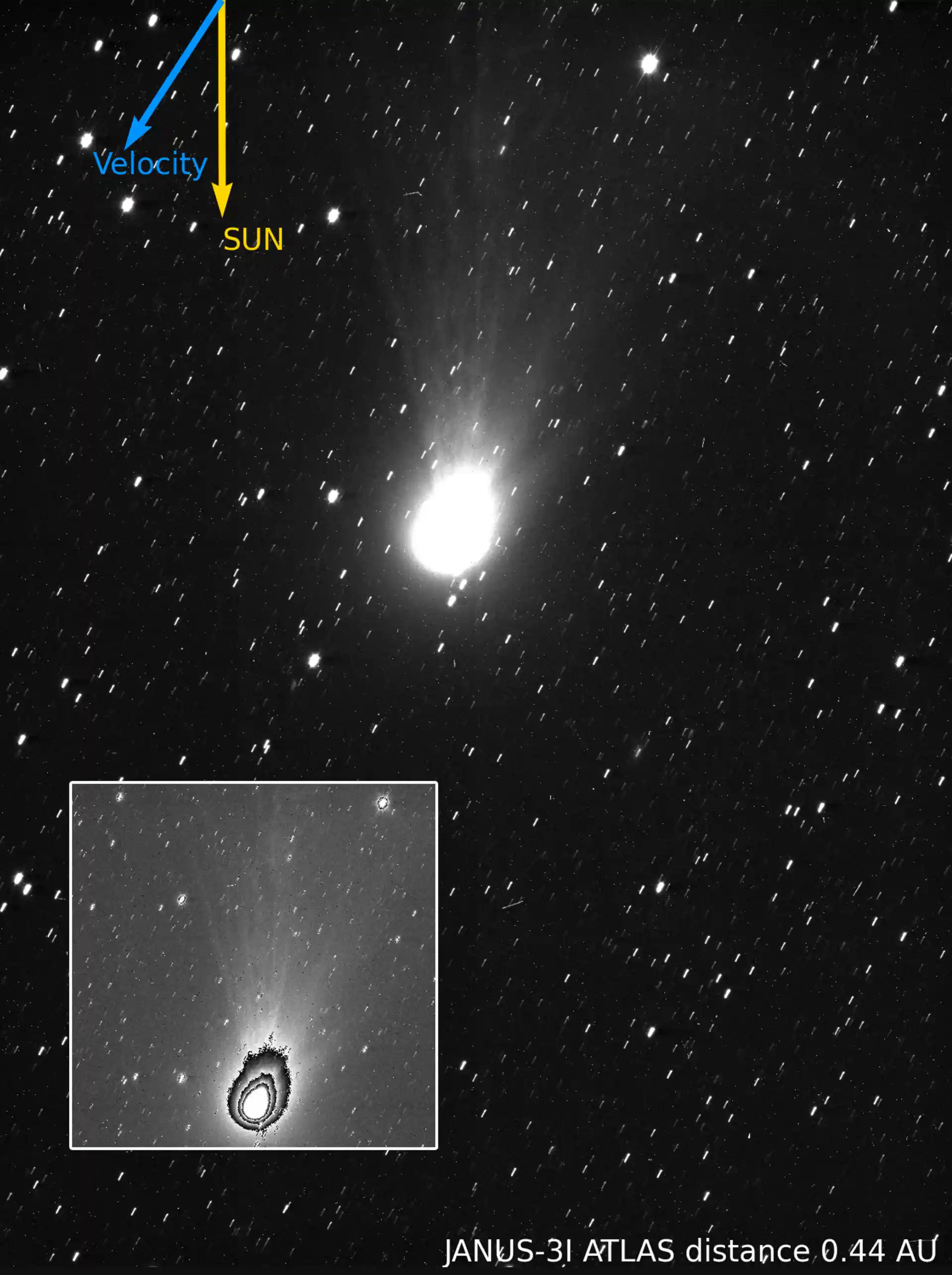
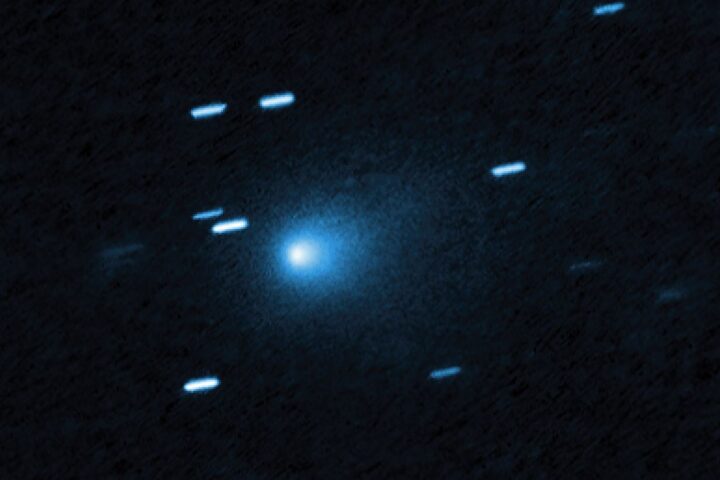
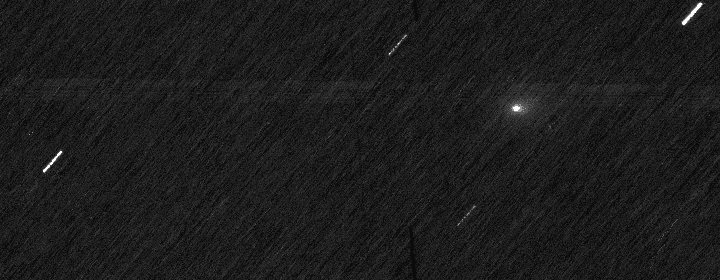
On 1 July 2025, the ATLAS survey telescope in Chile picked up an object moving too fast to belong here. Designated 3I/ATLAS, it became only the third confirmed visitor from outside our solar system — after 1I/ʻOumuamua in 2017 and 2I/Borisov in 2019. Its hyperbolic orbit, with an eccentricity of 6.14, confirmed it was not bound to the Sun’s gravity and was simply passing through on a journey that began — and will end — in the space between stars.
What followed was one of the most coordinated observation campaigns in modern astronomy. Space agencies across the world — NASA, ESA, and telescope teams operating the James Webb Space Telescope and Hubble — all pointed their instruments at this fleeting traveler. The goal: extract as much science as possible before it slips back into interstellar space, never to return.
The comet made its closest approach to Earth on 19 December 2025 at about 1.8 AU — roughly 170–275 million km away — posing no threat to our planet. As of early March 2026, it is heading toward its final planetary encounter with Jupiter before exiting our solar system for good.
Explore What the Data Shows
Select a topic to explore the science behind 3I/ATLAS in detail.
3I/ATLAS entered from the direction of the Sagittarius constellation — near the galactic center — and reached perihelion on 29 October 2025 at 1.36 AU from the Sun, just inside the orbit of Mars (1.52 AU). It then swung past Earth in December and is now heading outward toward Jupiter. Track its exact current position via NASA’s JPL Small-Body Database or the Eyes on the Solar System tool.
JWST NIRSpec spectroscopy data (Cordiner et al.) produced one of the most detailed chemical profiles ever obtained for an interstellar object. The standout finding: a CO₂-to-H₂O mixing ratio of approximately 8.0 ± 1.0 — among the highest ever measured in comets, solar or otherwise.
The high CO₂ dominance suggests 3I/ATLAS formed well beyond the CO₂ ice line in its home star system — in extremely cold conditions. This is also why it became active and visually bright far from our Sun, much earlier than solar system comets typically do: CO₂ sublimates at much lower temperatures than water ice. NASA’s Neil Gehrels Swift Observatory separately detected a hydroxyl (OH) ultraviolet glow — the photodissociation product of water — in 3I/ATLAS’s coma, with model-dependent production-rate estimates placing water loss at roughly 40 kg per second during peak activity (Xing et al., Auburn University).
Raw and calibrated JWST spectral data are publicly available via the Mikulski Archive for Space Telescopes (MAST). The preprint is accessible on arXiv (2508.18209).
ESA’s JUICE (Jupiter Icy Moons Explorer) spacecraft — en route to Jupiter — was uniquely positioned to observe 3I/ATLAS during November 2025, when the comet was in a “very active state” just days after its closest approach to the Sun.
Because JUICE was on the far side of the Sun from Earth after its observations, its main high-gain antenna was used as a heat shield. Detailed instrument data arrived only in late February 2026 via a slower medium-gain antenna link. Instrument science teams are scheduled to consolidate their multi-instrument findings in late March 2026. All JUICE image releases are catalogued on ESA’s multimedia page.
Only three interstellar objects have been confirmed in our solar system to date. Here is how they compare based on available data from NASA and peer-reviewed sources at arXiv.
| Object | Year Discovered | Type | Eccentricity | Entry Speed | Key Feature |
|---|---|---|---|---|---|
| 1I/ʻOumuamua | 2017 | Unknown (no coma) | 1.20 | ~26 km/s | Elongated, flat shape; unexplained acceleration; no gas detected |
| 2I/Borisov | 2019 | Confirmed comet | 3.36 | ~32 km/s | Clear coma & tail; CO-rich; most “normal” of the three |
| 3I/ATLAS | 2025 | Confirmed comet | 6.14 | ~61 km/s at discovery | Highest eccentricity & speed ever recorded; CO₂-dominated coma (8:1 CO₂/H₂O ratio); first hydroxyl detection for 3I/ATLAS; kinematic age estimates of 3–11 Gyr |
3I/ATLAS is the fastest and most eccentric of the three. It is also the most chemically characterized, thanks to JWST spectroscopy. Borisov was the first confirmed interstellar comet; ʻOumuamua remains the most debated due to its unusual shape and non-gravitational acceleration that could not be attributed to outgassing at the time of study.
“While 3I/ATLAS is a visitor from interstellar space, travelling from outside the Solar System, its behaviour is completely in line with that expected from a ‘normal’ comet.” — European Space Agency, JUICE mission team statement on the JANUS observations, February 2026 · esa.int/3IATLAS
How Big Is 3I/ATLAS?
Pinning down the size of an active comet nucleus is scientifically complex, since the bright coma of gas and dust surrounds and obscures the solid core. Teams using the Hubble Space Telescope estimated the nucleus at between 440 meters and 5.6 kilometers wide based on photometric analysis. A separate estimate from HST post-perihelion imaging work (Jewitt et al., arXiv:2508.02934) derived an effective radius close to 1.3 km under standard albedo assumptions, with the caveat that activity-driven non-gravitational forces make precise mass determination challenging.
For context, the trajectory data connects 3I/ATLAS to the Milky Way’s “thick disk” — a population of generally older stars. Kinematic analyses indicate the object may have a multibillion-year origin, with estimates spanning roughly 3–11 billion years depending on the model — which would make it potentially older than our Sun. These are model-dependent estimates, not confirmed measurements.
Where Is It Now?
As of early March 2026, 3I/ATLAS is heading outward past Jupiter, with its closest approach to that gas giant expected around 16 March 2026. After this final major planetary encounter, it will continue accelerating away from the Sun and into interstellar space — in a journey that will take centuries before it reaches another star system. The comet remains visible in the pre-dawn sky with small telescopes until approximately May 2026, according to NASA Science. After that, as it moves beyond 4 AU from the Sun, its activity will fade sharply.
Observers and astronomers can access real-time positional data through NASA’s JPL Small-Body Database, which provides up-to-date orbital elements and ephemerides. The ESA maintains a dedicated FAQ and updates page at esa.int/3IATLAS.
Track 3I/ATLAS in Real Time
NASA and ESA provide free tools to follow the comet’s exact position in our solar system, updated continuously.
Farewell to a Billion-Year-Old Traveler
This article covered the discovery of 3I/ATLAS on 1 July 2025 by the ATLAS survey, its confirmed status as the third interstellar object ever recorded, its orbital characteristics, and the multi-agency observation campaign that documented its passage through our solar system. The piece reviewed JUICE’s five-instrument observation campaign and the JANUS images, JWST NIRSpec spectroscopy findings indicating a CO₂-dominated coma with an approximately 8:1 CO₂-to-water ratio, Hubble nucleus size estimates, and unusual physical traits including the anti-tail, retrograde orbit tilt, and the first hydroxyl/water detection for 3I/ATLAS specifically via NASA’s Swift Observatory.
The data collected — spanning multiple space instruments and archived on MAST — will be studied by science teams for years. 3I/ATLAS’s brief transit through our solar neighborhood was documented with a level of scientific detail that was not possible when the first two interstellar objects passed through, a fact that was noted across space agency announcements.
All mission data for this object — images, spectra, ephemerides and instrument outputs — are available through the links in this piece for those who want to dig into the raw science themselves.